
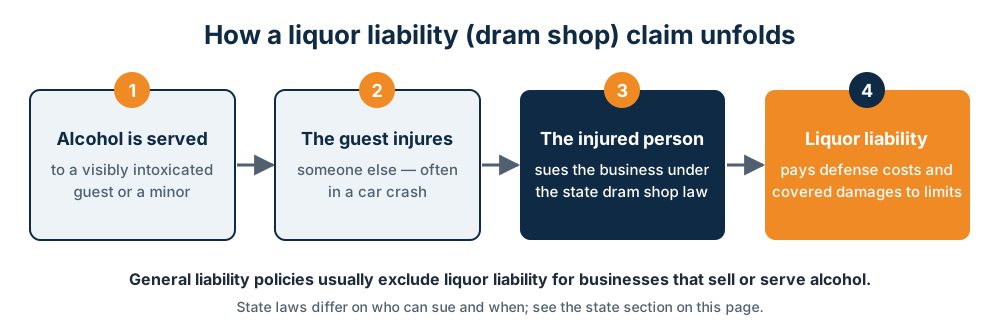
New Jersey restaurants and bars that serve alcohol face claims under the Licensed Alcoholic Beverage Server Fair Liability Act, N.J.S.A. 2A:22A-1 et seq., which makes a licensed server liable for serving a visibly intoxicated person or a minor it knew or should have known was underage. No statute requires liquor liability insurance, but general liability excludes these claims.
This guide is for New Jersey licensees and the BYOB restaurants that sit next to them: shore bars that triple their crowds in summer, late-night spots in Hoboken, casino-adjacent lounges in Atlantic City, and the neighborhood Italian place where guests carry in a bottle of wine. The New Jersey Division of Alcoholic Beverage Control (ABC), in the Office of the Attorney General, regulates licensees; the Fair Liability Act decides civil exposure.
How the Fair Liability Act assigns responsibility
Under N.J.S.A. 2A:22A-5, a licensed server is liable only when two things are true. First, it served a person who was visibly intoxicated, or served a minor when it knew or reasonably should have known the person was under the legal drinking age. Second, the injury was proximately caused by that service and was a foreseeable consequence of it. The injured party cannot simply point to a bar tab; they need evidence of what the patron looked like when served, or of how the minor got past your door.
Fault is then apportioned under comparative-negligence principles, so a jury can split responsibility between the drunk driver, the bar and others. That can reduce your share, but it also means you are in the case and paying lawyers from day one. No statutory dollar cap on damages was identified.
What New Jersey’s social host statute covers, and what it does not
N.J.S.A. 2A:15-5.5 to 5.8 makes social host liability the exclusive civil remedy against adult hosts, and it is narrow: a host is liable only for willfully and knowingly serving a visibly intoxicated adult guest, and only when the injury arose from that guest’s negligent operation of a vehicle. A blood alcohol concentration under 0.10% creates an irrebuttable presumption the guest was not visibly intoxicated. The statute covers guests of legal drinking age only; host liability for serving minors is governed by case law. For the difference between host coverage and a full liquor policy, see liquor liability vs. host liquor liability.
BYOB in New Jersey: legal, with strings attached
N.J.S.A. 2C:33-27 lets an unlicensed restaurant allow patrons to bring wine or malt beverages only. The restaurant cannot charge a cover, corkage or service charge for it, and cannot advertise BYOB. Municipalities may prohibit or regulate BYOB by ordinance, and violations are a disorderly persons offense. A guest who shows up with a bottle of vodka is outside the statute. Because a BYOB restaurant is not in the business of selling alcohol, its exposure is usually handled differently than a bar’s, but ask whether your policy’s host liquor coverage actually responds; see do BYOB restaurants need liquor liability?
Does New Jersey require liquor liability insurance?
No statute requires it. The requirement comes from contracts: landlords, lenders, license purchase agreements and event venues routinely demand proof of liquor liability, usually with additional insured status and minimum limits written into the document.
Server training is voluntary in New Jersey
New Jersey does not mandate responsible-server training. Programs such as TIPS are used voluntarily, and no statutory safe harbor tied to training was verified. Training still matters because the whole case turns on whether your server should have recognized visible intoxication or an underage guest, and a documented program with cut-off logs is the strongest evidence you have.
Where New Jersey liquor claims start
| Scenario | Fair Liability Act question | Coverage that responds |
|---|---|---|
| A shore bar packed on a summer Saturday serves a guest who later crashes on the parkway | Was he visibly intoxicated when served, and was the crash foreseeable? | Liquor liability; fault may be apportioned |
| A 20-year-old gets in with a convincing ID during a Hoboken bar crawl | Did you know or should you reasonably have known she was underage? | Liquor liability; ABC license exposure |
| A BYOB bistro lets a table open a bottle of whiskey | Outside the wine-and-malt limit of 2C:33-27 | Possibly uncovered; confirm host liquor terms |
| A bartender is hurt breaking up a fight | Employee injury, not a third-party claim | Workers’ compensation |
New Jersey requires workers’ comp with no minimum employee threshold, and rates run through the New Jersey Compensation Rating and Inspection Bureau rather than NCCI. See restaurant workers’ comp in New Jersey.
Assault and battery, and the gap in your GL
General liability excludes injury tied to causing someone’s intoxication once you sell alcohol. Liquor liability fills that gap, but assault and battery is often excluded or sublimited in both. For a late-night bar, confirm fights and security-staff actions are covered at full limits; see does liquor liability cover assault claims?
Per-occurrence vs. aggregate in a comparative-fault state
The per-occurrence limit caps what the carrier pays for one incident; the aggregate caps the policy year. Comparative fault can shrink your share of a verdict, but a serious crash with several injured people can still exhaust one occurrence. Ask whether defense erodes the limit and whether your umbrella sits over liquor.
New Jersey coverage checklist
- Liquor liability — covers Fair Liability Act suits your GL excludes
- Assault and battery at full limits — crowded summer weekends breed fights
- Defense outside the limit where available — comparative-fault cases run long
- Employees as insureds — bartenders are named personally
- Additional insured endorsements — landlords and license sellers require them
- Host liquor or BYOB coverage confirmed — for unlicensed restaurants
- Umbrella that follows form over liquor — no identified cap on damages
- Workers’ compensation — required from the first employee
What sets the price of New Jersey liquor coverage
Carriers rate primarily on annual alcohol receipts and on the share of revenue alcohol represents. A dinner house where wine is a small slice of sales rates very differently from a bar that lives on drinks. Seasonality, closing time, DJs, occupancy, security, ABC violations and prior claims all move the number. TIPS certificates, ID scanners and incident logs improve how underwriters see you.
Which New Jersey businesses face which issues
Bars carry the most visibly-intoxicated and assault exposure. Breweries add product liability. Caterers must know whether they or the venue hold the license. Fine dining rooms face over-service claims from long wine dinners, and many BYOB restaurants need only confirmed host coverage.
How quoting works with Provident Financial Group
Complete one application and Provident Financial Group compares liquor liability from multiple carriers side by side, including assault and battery terms. After binding, we issue certificates for landlords and venues. Call (866) 964-6660. For the full package, see restaurant insurance in New Jersey.
Frequently asked questions
When is a New Jersey bar liable for a drunk driver?
When it served someone visibly intoxicated, or a minor it knew or should have known was underage, and the injury was a proximate and foreseeable result (N.J.S.A. 2A:22A-5).
Can a New Jersey BYOB restaurant charge corkage?
No. Under N.J.S.A. 2C:33-27, unlicensed restaurants cannot charge a cover, corkage or service fee for BYOB and may allow only wine or malt beverages.
Is server training required in New Jersey?
No. It is voluntary, but documented training is the best evidence that your staff watched for visible intoxication and underage guests.
Is liquor liability required to hold a New Jersey license?
No statute requires it, but leases, lenders and license purchase agreements usually do.
See what New Jersey carriers will offer. Get Multiple Quotes within minutes.
Official New Jersey sources
- N.J.S.A. 2A:22A-5 (Licensed Alcoholic Beverage Server Fair Liability Act)
- New Jersey Courts: Model Civil Jury Charge 5.71
- N.J.S.A. 2A:15-5.6 (social host liability)
- N.J.S.A. 2C:33-27 (BYOB at unlicensed restaurants)
State facts on this page are drawn from the statutes and agency pages above. Laws and agency rules change, so confirm current requirements with the agency before relying on them. This page is general information, not legal advice or a coverage opinion.
Related pages
- Restaurant insurance in New Jersey
- Bar insurance in New Jersey
- Brewery insurance in New Jersey
- Catering insurance in New Jersey
- Fine dining insurance in New Jersey
- Restaurant insurance in Jersey City
- Per-occurrence vs. aggregate limits