
Restaurants in Jersey City, NJ typically need general liability, property with business interruption, workers’ compensation, and liquor liability when alcohol is served, plus separate flood coverage near the waterfront. The New Jersey rule that matters most is that workers’ comp applies from the very first employee, and corporate officers who draw pay count, so there is no small-business exemption to lean on.
Jersey City’s dining scene ranges from ground-floor spaces in waterfront residential towers to family restaurants in the Heights and Journal Square and fast-growing food halls. We are Provident Financial Group, an independent agency headquartered in Mendham, New Jersey, and we write Hudson County restaurants regularly.
The Jersey City factors underwriters care about
A large share of new restaurants here sign leases with institutional landlords that own high-rise residential or office towers. Those leases tend to be long and specific: additional insured status for the landlord and its property manager, primary and non-contributory wording, waiver of subrogation, minimum umbrella limits and a certificate before you get the keys. Missing one clause can stall an opening, so we read the insurance section of the lease before we quote.
Location along the Hudson matters too. Coastal New Jersey took heavy storm-surge flooding during Superstorm Sandy in 2012, and waterfront basements that hold dry storage, walk-ins or mechanical rooms are exactly where water goes. Standard property forms and business owner’s policies exclude flood, so it has to be bought separately through the National Flood Insurance Program or a private flood market.
Commuter rhythms drive sales. PATH and light-rail riders create short, intense breakfast and lunch rushes, and dense apartment living keeps delivery and online ordering busy late into the evening. That means more card data, more third-party app integrations and more people on the road on your behalf.
State rules every Jersey City owner should know
- Workers’ comp: every corporation with a paid individual, and every LLC, partnership or sole proprietor with a non-owner employee, must insure through a private carrier. Rates are set using NJCRIB classifications. Details are on our New Jersey restaurant workers’ comp page.
- Temporary Disability and Family Leave Insurance: employers participate through state payroll contributions or an approved private plan, and must post the required notices.
- Liquor liability: the Licensed Alcoholic Beverage Server Fair Liability Act holds licensees liable for foreseeable injuries after serving a visibly intoxicated guest or a minor. Insurance is not mandated by statute but is standard in tower leases.
- Auto: 35/70/25 (in thousands of dollars) minimum liability for policies issued or renewed on or after January 1, 2026, in a no-fault state.
- Food safety: the local health department licenses and inspects under N.J.A.C. 8:24, and Risk Type 3 kitchens need a certified food protection manager in charge.
Losses that hit Jersey City restaurants hardest
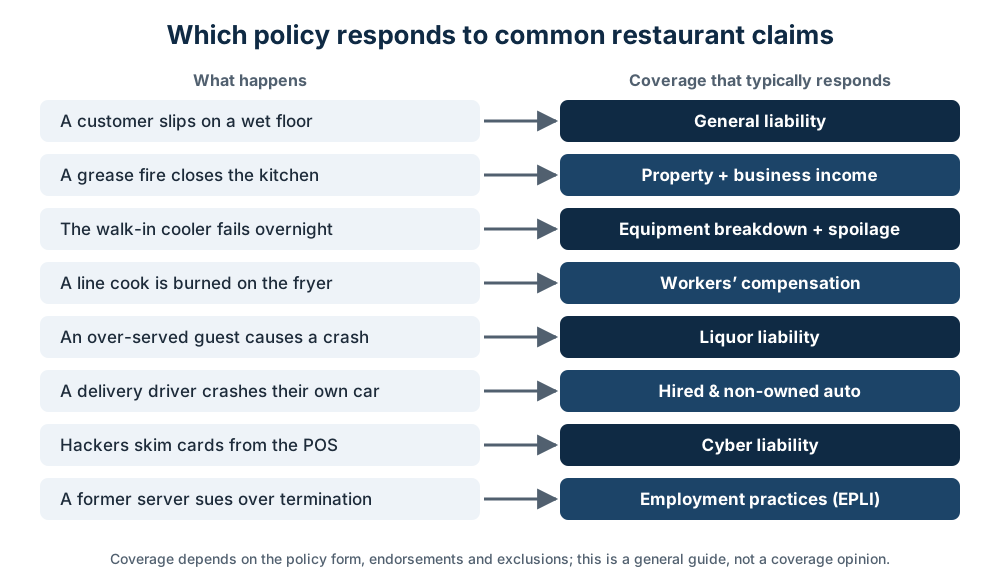
Water from above is a recurring theme in towers: a failed supply line in a unit upstairs pours into your dining room, and you are closed while the building sorts out responsibility. Business interruption coverage tied to a covered property loss is what keeps payroll and rent paid during the shutdown. A second scenario is a courier hired directly by the restaurant, riding an e-bike or driving a personal car, who injures a pedestrian; hired and non-owned auto and a clear written delivery policy both matter here. Third, online ordering systems are a target for card skimming and ransomware, and a breach notice to every customer is expensive to handle without cyber coverage.
Coverage checklist for a Jersey City restaurant
- General liability — foot-traffic injuries and foodborne illness claims, with the landlord added as additional insured.
- Property and tenant improvements — the build-out you paid for in a tower space is usually yours to insure.
- Business interruption and extra expense — lost income and relocation costs after a covered loss.
- Flood insurance — a separate policy for waterfront and low-lying locations.
- Workers’ compensation and employer’s liability — required from the first hire.
- Liquor liability — for any licensed pour, including assault and battery coverage if you run a late bar.
- Hired and non-owned auto — for delivery staff using their own vehicles.
- Cyber liability — online ordering, POS and customer data.
- Umbrella — to meet tower lease minimums.
Rating factors for Jersey City premiums
Pricing depends on sales mix, alcohol share, hours, payroll by job class, flood zone, building construction and sprinkler status, and claim history. Newer sprinklered towers often help on property, while flood zone and below-grade storage raise flood pricing. Documented hood cleaning, raised storage for inventory, a written delivery policy and staff ID-check training all show underwriters you manage risk.
Getting quoted through an independent agency
One application goes to multiple carriers quoted through our agency, and we present them side by side with the lease requirements checked off. After binding, we send certificates straight to your landlord or property manager. Questions? Call (866) 964-6660.
Frequently asked questions
What does primary and non-contributory mean in my tower lease?
It means your policy pays before the landlord’s own insurance and does not ask the landlord’s carrier to share the loss. Many carriers can add it by endorsement.
Is flood covered by my business owner’s policy?
No. Flood is excluded on standard business owner’s and property forms, so waterfront locations need a separate flood policy.
Do weekend-only part-timers count for workers’ comp?
Yes. New Jersey has no minimum employee threshold, so part-time and weekend staff must be covered and reported on payroll.
Can one policy cover a waterfront location and a second spot in the Heights?
Usually yes. Most carriers schedule multiple locations on one package, with location-specific flood and property details.
See what your Jersey City restaurant qualifies for, subject to underwriting and policy terms. Get Multiple Quotes within minutes.
Official New Jersey sources
- N.J.S.A. 2A:22A-5 (Licensed Alcoholic Beverage Server Fair Liability Act)
- New Jersey Division of Workers' Compensation: employer requirements
- New Jersey Department of Health: retail food program
- N.J.A.C. 8:24-2.1 (person in charge; certified food protection manager)
State facts on this page are drawn from the statutes and agency pages above. Laws and agency rules change, so confirm current requirements with the agency before relying on them. This page is general information, not legal advice or a coverage opinion.