
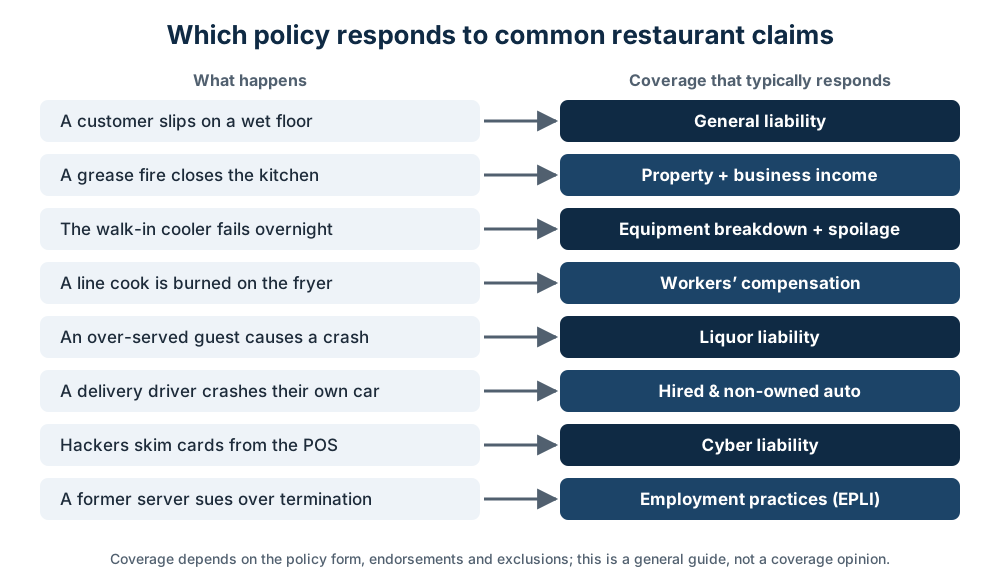
Restaurants in Sacramento typically need general liability, property and business income, workers’ compensation from the first hire, liquor liability for any alcohol service, and food contamination or spoilage coverage. The California rule that matters most is Responsible Beverage Service (RBS) certification, required within 60 days of hire for servers and managers, alongside WCIRB’s 2024 restaurant class-code split for workers’ comp.
This guide is written for Sacramento owners of farm-to-fork dining rooms, midtown cocktail bars, government-district lunch spots, taquerias and caterers serving events around the Capitol.
Farm-to-fork, the Capitol and Central Valley weather
Sacramento is California’s capital and calls itself America’s Farm-to-Fork Capital. Many kitchens buy directly from nearby farms and ranches, which is great for menus but means tracking suppliers, allergens and product recalls carefully. Weekday traffic follows the government calendar, with legislative sessions, lobbyist lunches and receptions driving private events and catering. Downtown arena games and concerts add evening surges.
Central Valley summers are hot, which strains refrigeration and puts line cooks at risk of heat illness. The city sits where two major rivers meet, so owners in low-lying areas should know that standard commercial property usually excludes flood; a separate flood policy may be worth pricing. Earthquake damage is also usually excluded, according to the California Department of Insurance, and some owners in wildfire-exposed foothill areas can only place property with the California FAIR Plan, often paired with Difference in Conditions (DIC) coverage.
Sacramento compliance checkpoints
Responsible Beverage Service: Anyone who checks ID, takes alcohol orders, pours or delivers alcohol at an on-premises ABC licensee must be RBS certified within 60 days of hire, and so must their managers. Certification lasts 3 years, and uncertified servers expose the license to ABC administrative action. On the liability side, Business and Professions Code §25602.1 lets injured parties sue a licensee that served an obviously intoxicated person under 21.
Workers’ comp: California requires coverage from the first employee, family members included (Labor Code §3700). For policies starting on or after September 1, 2024, WCIRB assigns 9080 to full-service restaurants, 9083 to fast food or fast casual, 9081(1) to other restaurants, 9084 to bars and 9082 to caterers. Operating uninsured is a misdemeanor and triggers a stop order.
Food safety: Local environmental health agencies inspect under the California Retail Food Code. One owner or employee must hold a state-approved food safety certification, and all food handlers need a California Food Handler Card within 30 days of hire.
Loss scenarios for Sacramento restaurants
- A salad made with locally sourced greens is linked to illness among reception guests, a products liability claim.
- A summer power outage takes down the walk-in during a heat wave and product is lost, a spoilage loss.
- A prep cook develops heat exhaustion in a kitchen without adequate cooling, a workers’ comp claim.
- After a downtown game, an over-served patron under 21 leaves your bar and injures a cyclist, a §25602.1 claim.
- A low-lying location takes on water during heavy winter rains; without separate flood coverage, the loss may not be covered.
Coverage worth carrying in Sacramento
- General liability with products coverage — farm-sourced ingredients and catered events.
- Food contamination and spoilage — product recalls, health department closures and outages.
- Liquor liability — bar and banquet service, including special events.
- Commercial property and business income — fire and theft, plus lost income.
- Flood (separate policy) — river-adjacent or low-lying locations.
- Earthquake or DIC — earthquake damage excluded from standard property.
- Workers’ compensation — required and rated under the new WCIRB codes.
- Hired and non-owned auto — staff delivering catering to Capitol-area offices.
Sacramento pricing: what underwriters weigh
Premiums reflect your WCIRB class and payroll, experience mod, alcohol sales, event and catering volume, building construction, flood zone and wildfire exposure, and loss history. Supplier documentation, allergen training, cooling measures in the kitchen, generator or backup plans for refrigeration and current RBS records all strengthen your submission.
Quoting with an independent agency
Provident Financial Group sends one application to multiple carriers and lays out the options side by side, including flood and earthquake add-ons. After binding, we issue live certificates of insurance for landlords, venues and event planners. Call (866) 964-6660 to talk it through.
Frequently asked questions
Does buying from local farms change my liability coverage?
It makes products liability and supplier documentation more important. Carriers look favorably on written sourcing and recall procedures.
Is flood covered by my Sacramento restaurant’s property policy?
Usually not. Flood is a standard exclusion and needs a separate policy.
Do banquet servers at private events need RBS certification?
Yes, when they serve alcohol for an on-premises ABC licensee. The requirement covers anyone who checks ID, takes orders, pours or delivers drinks.
Which workers’ comp code fits a fast casual counter?
WCIRB code 9083 covers fast food and fast casual restaurants; full-service dining falls under 9080.
Start your comparison. Get Multiple Quotes within minutes.
Official California sources
- California ABC: licensee laws and liability
- California Division of Workers' Compensation: FAQ
- San Diego County Environmental Health: food handler card
- Sonoma County Environmental Health: food handler card
- California Department of Insurance: California FAIR Plan
State facts on this page are drawn from the statutes and agency pages above. Laws and agency rules change, so confirm current requirements with the agency before relying on them. This page is general information, not legal advice or a coverage opinion.