
Restaurants in Newark, NJ typically need general liability, commercial property, workers’ compensation and, if they pour alcohol, liquor liability, often bundled with a business owner’s policy and paired with hired and non-owned auto for delivery. The New Jersey rule that matters most is workers’ comp: nearly every employer must carry it from the first paid worker, and a corporation must insure even if the only person on payroll is an officer.
This page is for owners running Ironbound dining rooms, downtown lunch counters, event-night bars and neighborhood takeout spots. Provident Financial Group is an independent agency based in Mendham, New Jersey, so Essex County restaurants are close to home for us.
What makes Newark different for a restaurant policy
Newark packs several dining economies into one city. The Ironbound is known for Portuguese, Spanish and Brazilian restaurants, many built around charcoal grills, rotisseries and rodizio-style service, which means heavy open-flame cooking and long hours. Downtown runs on weekday office, courthouse and university traffic, then fills with crowds on arena and concert nights. Airport and port workers keep early and late takeout busy.
Much of the building stock is older masonry with apartments above the storefront, so carriers look hard at wiring, sprinklers and hood systems. Street parking is tight, and owners who send staff out on deliveries in personal cars carry auto exposure they may not realize they have.
New Jersey requirements, applied to a Newark operation
Workers’ compensation. There is no minimum employee count; LLCs, partnerships and sole proprietors must insure once they employ anyone beyond the owners. Coverage comes from private carriers using New Jersey Compensation Rating & Inspection Bureau (NJCRIB) classifications. Going uninsured is a disorderly persons offense, a knowing failure can be a fourth-degree crime, and the state can issue stop-work orders. Employers also fund Temporary Disability and Family Leave Insurance. See our New Jersey restaurant workers’ comp guide.
Liquor. Under the Licensed Alcoholic Beverage Server Fair Liability Act (N.J.S.A. 2A:22A-1 et seq.), a licensee can be liable for serving a visibly intoxicated person, or a minor it knew or should have known was underage, when that service foreseeably causes injury. Insurance is not mandated by statute, but landlords and lenders routinely require it. Unlicensed restaurants may let guests bring wine or beer only, with no corkage or cover and no BYOB advertising, and towns can restrict the practice.
Delivery. For policies issued or renewed on or after January 1, 2026, New Jersey’s minimum auto liability is 35/70/25 (in thousands of dollars) in a no-fault (PIP) system. Food safety: the local health department licenses and inspects under N.J.A.C. 8:24, and Risk Type 3 operations need a certified food protection manager in charge.
Claim scenarios worth planning for in Newark
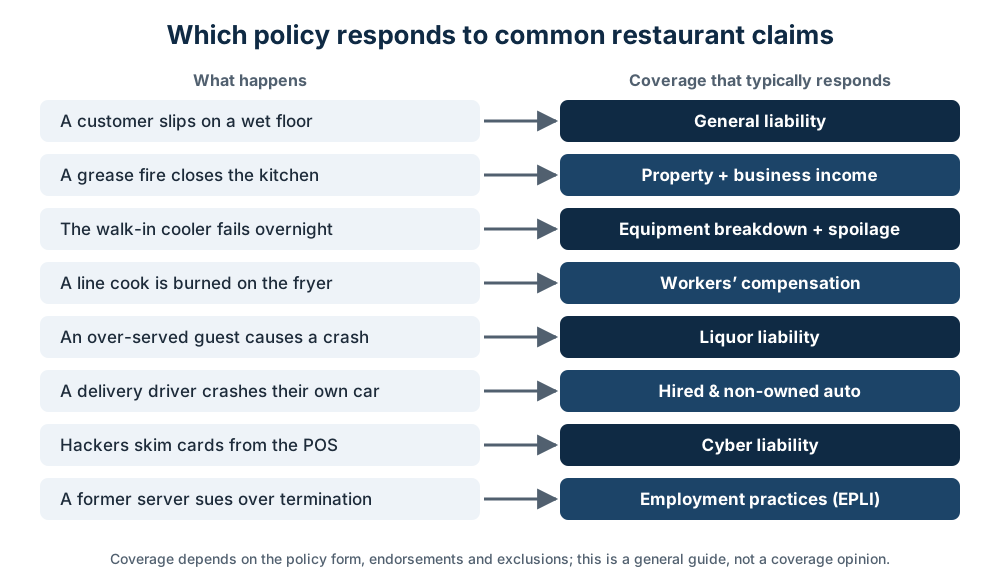
- A grease flare-up at a charcoal grill travels into the ductwork and smoke-damages the apartments upstairs.
- A guest leaves after too many rounds on an arena night, causes a crash, and the injured driver names your bar.
- A counter worker delivering lunch in his own car hits a pedestrian, and the claim climbs past his personal policy to you.
- A January freeze splits a pipe in an unheated back room, closing the kitchen for weeks.
Newark restaurant coverage checklist
- General liability — slip-and-fall and foodborne illness claims from heavy walk-in traffic.
- Commercial property — grills, kitchen equipment, furniture and improvements you paid for.
- Business interruption — lost income while a fire or water loss keeps you closed.
- Workers’ compensation — required from the first hire; covers burns, cuts and strains.
- Liquor liability — responds to Fair Liability Act claims that general liability excludes.
- Hired and non-owned auto — for staff delivering in personal vehicles.
- Equipment breakdown and spoilage — walk-in and compressor failures.
- Umbrella — extra limits that larger landlords often require.
What pushes the premium up or down
Carriers weigh cooking method, alcohol share of sales, closing time, payroll by job class, building age and protection, and prior claims. Solid-fuel cooking and late hours tend to raise rates; a UL 300 suppression system, documented hood cleaning, sprinklers, ID-check training and a clean loss history help. Accurate payroll by classification prevents surprises at the comp audit.
How quoting works with Provident Financial Group
You fill out one application, we shop it with multiple carriers quoted through our agency, and we lay the options side by side so you compare limits, exclusions and deductibles, not just price. After you bind, we issue certificates of insurance your landlord, lender or venue can receive the same day. Prefer to talk? Call (866) 964-6660.
Frequently asked questions
My family-run Ironbound restaurant is an LLC and only relatives work there. Do we need workers’ comp?
If anyone other than the LLC’s members is on payroll, including a paid cousin or nephew, New Jersey requires coverage.
We are BYOB. Do we still need liquor liability?
You are not a licensed server, but guests drinking on your premises can still lead to claims. Many carriers offer BYOB liability endorsements, and some landlords insist on them.
How fast can I get a certificate for my landlord?
Usually the same day you bind, with the additional insured wording your lease requires.
Does arena-night traffic change how carriers see my bar?
It can. Underwriters ask about peak crowds, security and closing time, and a written ID-check and cut-off plan helps.
See what your Newark restaurant qualifies for, subject to underwriting and policy terms. Get Multiple Quotes within minutes.
Official New Jersey sources
- N.J.S.A. 2A:22A-5 (Licensed Alcoholic Beverage Server Fair Liability Act)
- New Jersey Division of Workers' Compensation: employer requirements
- New Jersey Department of Health: retail food program
- N.J.A.C. 8:24-2.1 (person in charge; certified food protection manager)
State facts on this page are drawn from the statutes and agency pages above. Laws and agency rules change, so confirm current requirements with the agency before relying on them. This page is general information, not legal advice or a coverage opinion.