
Breweries and taprooms in Vermont typically need liquor liability for pints and flights poured on site, product liability for cans and kegs that leave the building, commercial property and equipment breakdown for tanks and glycol chillers, and workers’ compensation for every employee. Vermont’s dram shop law and its newer licensee insurance requirement both reach licensed on-premises service, so taproom pours carry real legal exposure.
This page is for Vermont craft brewers with a tasting room or beer garden, brewpubs, and production breweries that pour on site while distributing to stores and bars. Beer tourism brings weekend crowds, tour groups and cyclists to your taproom, while the production floor carries manufacturing-style hazards that a standard restaurant policy was never built to handle.
Vermont rules that shape a brewery’s insurance
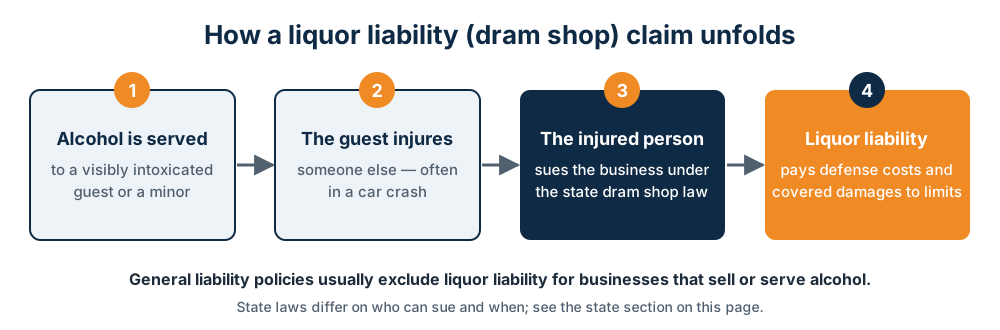
Under 7 V.S.A. § 501, a person injured by an intoxicated patron can sue a first-, third- or fourth-class licensee that served a minor, served after legal hours, or negligently kept serving someone apparently under the influence. There is no statutory damages cap, and case law applies a two-year limitation period. If your taproom operates under one of those license classes, the flight you pour a visitor who then drives back over a mountain pass is squarely within the statute. Confirm your license class with the Department of Liquor and Lottery (DLL).
Act 17 of 2023 then added a requirement that first-, third- and fourth-class licensees carry liquor liability insurance meeting minimums set by DLL rule, with input from the Department of Financial Regulation, as a condition of issuing or renewing the license. The dollar minimum lives in the rule, not the statute, and the effective date has moved since enactment, so check DLL’s current guidance before renewal rather than relying on an old memo.
Your taproom staff also need DLL-approved seller-server training before they pour and every two years after. And because Vermont requires workers’ compensation with a single full- or part-time employee, even a two-person brewhouse with a weekend bartender needs a comp policy.
Brewhouse and taproom hazards specific to craft beer
On the production side, the injuries look industrial: a brewer scalded by hot wort during a transfer, chemical burns from caustic tank cleaners, a back strain from stacking half-barrel kegs, or a worker overcome by CO2 while cleaning a fermenter. Those are workers’ compensation claims, and underwriters will ask how you monitor gas levels and handle confined-space entry.
Product exposure follows your beer out the door. Imagine a batch with a secondary fermentation problem: over-carbonated cans swell and burst on a retailer’s shelf, cutting a shopper, and the store tenders the claim back to you. Or a lot contains glass fragments from a broken bottle-filler part. Products-completed operations coverage handles the injury; recall expense coverage pays to pull and destroy the batch, which general liability usually does not.
The taproom adds visitor risk: a tour participant slips on a wet brewhouse floor, a dog on the patio bites a child, or a food truck parked on your lot sickens customers and its insurer points at you. Winter adds another layer—a glycol chiller that fails during a power outage, water lines freezing in an unheated grain room, heavy snow on a metal production building, and flood exposure for breweries in river valleys.
Brewery coverage checklist for Vermont producers
- Liquor liability — for taproom and brewpub service under § 501 and the licensee insurance requirement.
- General liability with products-completed operations — covers visitor injuries and harm caused by beer you distributed.
- Product recall expense — pays to retrieve, destroy and replace a contaminated or defective batch.
- Commercial property — brewhouse, tanks, canning line, and finished inventory, ideally valued at selling price.
- Equipment breakdown and spoilage — glycol, boilers, compressors and the beer lost when they fail.
- Business income — keeps revenue flowing if a fire or covered loss halts production for weeks.
- Commercial auto or hired and non-owned auto — for keg deliveries and festival runs; Vermont’s minimum is 25/50/10 (in thousands of dollars), far below what distributors expect.
- Workers’ compensation — required with even one employee.
- Umbrella liability — additional limit for a serious taproom or product claim.
What underwriters weigh when pricing a brewery
Carriers look at annual production, how widely you distribute, the split between taproom sales and wholesale, whether you host festivals, tours or live music, your hours, building construction and sprinklers, flood zone, and loss history. A taproom that closes early and serves food rates differently from a late-night beer hall.
You can influence the result: document CO2 monitoring and confined-space procedures, keep lot codes and a written recall plan, collect certificates from every food truck and event vendor on your property, keep server training records current, and maintain the glycol system on a schedule with alarms that text you when temperatures drift.
Comparing brewery quotes with Provident Financial Group
Provident Financial Group is an independent agency, and US Restaurant Insure is our food-and-beverage brand. You fill out one application covering the taproom, production and distribution, and we compare offers from multiple carriers quoted through our agency side by side. After binding, you get live certificates of insurance for distributors, festivals and your landlord. Call (866) 964-6660 with questions.
Frequently asked questions
Does Vermont’s dram shop law apply to taproom tastings?
It applies to first-, third- and fourth-class licensees that serve unlawfully or negligently as § 501 describes. If your taproom operates under one of those licenses, a flight poured there is within its reach; confirm your license class with DLL.
Do I need product liability if a distributor sells my beer?
Yes. Distributors and retailers usually ask to be named as additional insureds on your products coverage, and a claim over a defective can or contaminated batch traces back to the brewer.
What auto minimums apply to my delivery van in Vermont?
Vermont’s minimum liability is 25/50/10 (in thousands of dollars) under 23 V.S.A. § 800. Most distributors and event organizers ask for considerably higher commercial limits.
Is a glycol chiller failure covered?
Equipment breakdown coverage generally responds to sudden mechanical or electrical failure, and spoilage coverage can pick up the beer that is lost. Standard property alone often does not.
Ready to see how carriers price your brewhouse and taproom? Get Multiple Quotes within minutes.