
Restaurants in San Jose typically need general liability, property with business income, workers’ compensation from the first employee, liquor liability if alcohol is served, and commercial or hired auto for catering and delivery. The California rule that matters most is getting the workers’ comp class right: since September 1, 2024, the WCIRB rates restaurants, fast casual counters, bars and caterers under separate codes, and many San Jose operators do more than one of those.
This page is for San Jose owners of strip-center pho and banh mi shops, downtown gastropubs, office-park lunch counters and caterers that feed corporate campuses across Silicon Valley.
San Jose: a Silicon Valley lunch-and-catering economy
As the largest city in Silicon Valley, San Jose runs heavily on weekday business. Many restaurants depend on the lunch rush from nearby offices and on catering orders for meetings, launches and company events. That brings contract requirements into the picture: corporate clients and event venues often want specific liability limits, additional insured endorsements, waivers of subrogation and certificates before your van pulls into the loading dock. Much of the city is suburban, so restaurants often sit in shopping centers with shared lots, and nearly everything moves by car. Downtown arena events and nightlife create a separate, late-evening crowd.
Seismic risk is part of doing business anywhere in the Bay Area. The California Department of Insurance warns that commercial property insurance usually does not cover earthquake damage, so owners buy a separate earthquake policy or Difference in Conditions (DIC) coverage. Hot inland summers also put stress on refrigeration and HVAC.
How California law lands on a San Jose operation
Workers’ comp classification: Labor Code §3700 requires coverage for every employer with at least one employee, and being uninsured is a misdemeanor. WCIRB codes now include 9080 (full service), 9081(1) (restaurants N.O.C.), 9083 (fast food or fast casual), 9084 (bars, not restaurants) and 9082 (caterers, not restaurants). A counter-service shop that also runs a big catering book may need its payroll reviewed so each operation is classified correctly. California’s 9082 and 9083 are not the same as NCCI codes with those numbers, so out-of-state class descriptions do not carry over.
Vehicles: California’s minimum auto liability rose to 30/60/15 (in thousands of dollars) on January 1, 2025. Corporate catering contracts often require higher limits than the state minimum, and staff who use their own cars for drop-offs need hired and non-owned auto coverage behind them.
Alcohol and food safety: Servers and managers at on-premises ABC licensees need RBS certification within 60 days of hire, renewed every 3 years. Business and Professions Code §25602.1 exposes licensees to suits for serving obviously intoxicated guests under 21. Food handlers need a California Food Handler Card within 30 days of hire, and one person on staff must hold a state-approved food safety certification.
Typical San Jose restaurant claims
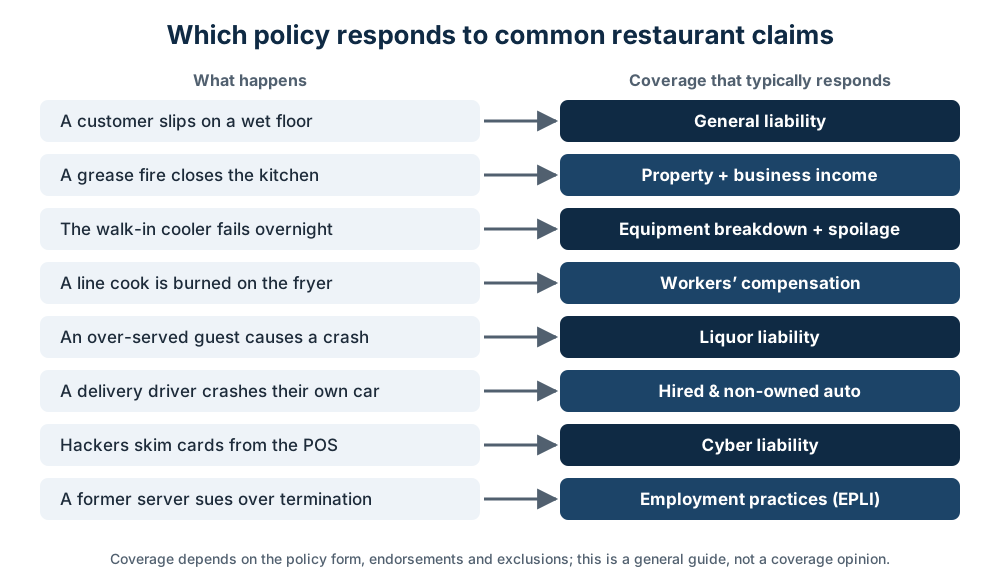
- A catering van delivering to an office campus clips a pedestrian in the parking structure, a commercial auto claim.
- Attendees at a corporate event you catered report foodborne illness, a products and completed operations liability claim.
- A walk-in compressor dies during a heat wave and the week’s inventory spoils, an equipment breakdown loss.
- A shopper trips on a broken curb outside your strip-center unit and names both you and the landlord.
- A prep cook cuts a hand badly during a large catering prep, a workers’ comp claim.
San Jose restaurant and catering coverage list
- General liability with products and completed operations — food you serve on-site and at client locations.
- Commercial auto — owned catering vans at limits that satisfy corporate contracts.
- Hired and non-owned auto — employees delivering in personal vehicles.
- Workers’ compensation — correctly split between restaurant and catering classes.
- Liquor liability — bar service at your location and at catered events.
- Commercial property and business income — build-out, equipment and lost income.
- Equipment breakdown and spoilage — refrigeration strained by summer heat.
- Cyber liability — online ordering portals and corporate invoicing data.
What pushes San Jose premiums up or down
Carriers look at your class split and payroll, experience mod, catering revenue and off-site event volume, vehicle count and driver records, alcohol sales, building construction, earthquake exposure and loss history. Written driver standards, allergen labeling on catering trays, temperature logs for transport, RBS records and a maintenance contract on refrigeration show underwriters a well-managed account.
How Provident Financial Group quotes your account
You complete one application. As an independent agency, we take it to multiple carriers and compare the results side by side, including any contract-required endorsements. After you bind, we issue live certificates of insurance you can send to corporate clients and venues the same day. Call (866) 964-6660 with questions.
Frequently asked questions
My restaurant also caters office events. Do I need separate workers’ comp classes?
Possibly. WCIRB code 9082 applies to caterers that are not restaurants, so we review how your catering operates before assigning classes.
Why do corporate clients ask for additional insured status?
It extends your liability coverage to the client for claims arising from your work, subject to policy terms, and most contracts require it before you serve.
Does hot weather affect my insurance?
Heat increases refrigeration failures, so equipment breakdown and spoilage coverage is worth adding. Standard property forms may not cover mechanical breakdown.
Do I need earthquake coverage in San Jose?
It is not legally required, but commercial property generally excludes earthquake, so many owners add a separate policy or DIC.
Compare carriers for your San Jose location. Get Multiple Quotes within minutes.
Official California sources
- California ABC: licensee laws and liability
- California Division of Workers' Compensation: FAQ
- San Diego County Environmental Health: food handler card
- Sonoma County Environmental Health: food handler card
- California Department of Insurance: California FAIR Plan
State facts on this page are drawn from the statutes and agency pages above. Laws and agency rules change, so confirm current requirements with the agency before relying on them. This page is general information, not legal advice or a coverage opinion.