
Restaurants in San Francisco typically need general liability, property and business income, a separate earthquake or Difference in Conditions policy, workers’ compensation from the first hire, and liquor liability wherever alcohol is served. The California rule that matters most day to day is Responsible Beverage Service (RBS) certification: every server and manager at an on-premises ABC licensee must be certified within 60 days of hire.
This page is for owners of San Francisco dim sum houses, neighborhood bistros, wine bars, bakery-cafes and tourist-facing seafood spots near the waterfront. It focuses on the exposures that come with operating in a dense, older, expensive city.
Operating in a dense, older city: what underwriters notice
San Francisco is compact and walkable, with heavy tourism and convention traffic and a strong weekday office lunch trade. Many restaurants occupy the ground floor of mixed-use buildings with apartments or offices above. That arrangement cuts both ways: a grease fire or smoke from your kitchen can damage upstairs tenants and lead to a liability claim, while a burst pipe or overflowing tub upstairs can shut your dining room. Much of the building stock is old, so underwriters ask about wiring, plumbing updates, sprinklers and seismic retrofits.
Commercial rents are high, so leases tend to be long and detailed. Expect landlords to require specific liability limits, additional insured status, waiver of subrogation, plate glass coverage and business income. Reading those clauses before you sign avoids a scramble at opening.
Earthquake is the defining catastrophe risk here. The California Department of Insurance warns that commercial property insurance usually does not cover earthquake damage, so you need a separate earthquake policy or Difference in Conditions (DIC) coverage for the building, your improvements and the income lost while you are closed.
State law as it plays out in San Francisco
Workers’ compensation is required under Labor Code §3700 for any employer with one or more employees, including family members, and operating uninsured is a misdemeanor that brings a stop order on employee labor. Since September 1, 2024, the WCIRB rates full-service restaurants under 9080, fast food and fast casual under 9083, bars that are not restaurants under 9084 and caterers under 9082. A wine bar with small plates and a sit-down bistro may land in different codes, so the classification deserves a careful look.
Alcohol service: California limits dram shop claims, but Business and Professions Code §25602.1 allows suits against a licensee that serves an obviously intoxicated person under 21 who then causes injury or death. Licensees also owe guests a common-law duty of reasonable care. RBS certificates are valid for 3 years. Staff also need a California Food Handler Card within 30 days of hire, and at least one person must hold a state-approved food safety certification.
Where San Francisco restaurant claims come from
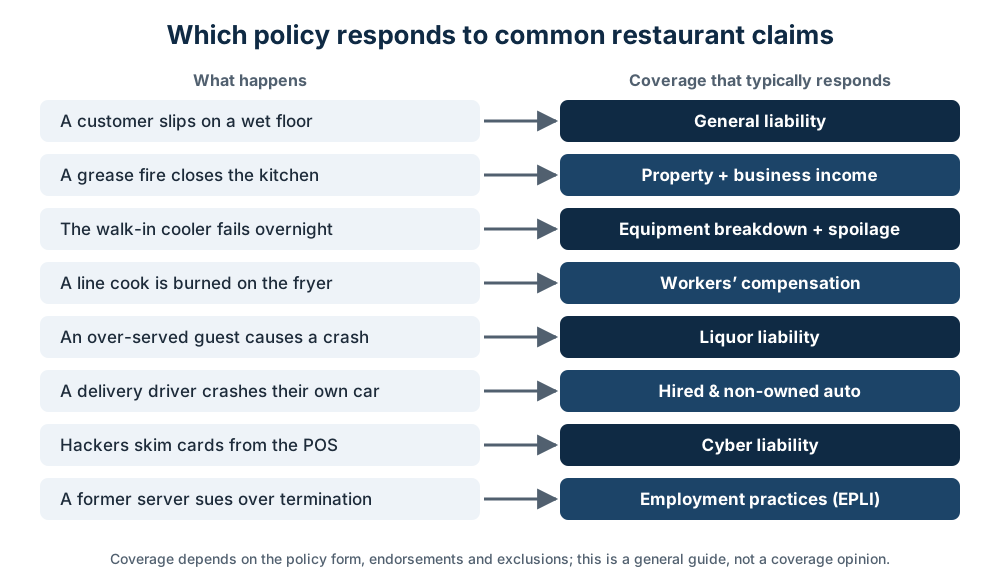
- Water from an upstairs unit pours through the ceiling on a Saturday, forcing a closure; property and business income respond, subject to policy terms.
- Smoke from your kitchen fire damages the apartments above and the residents sue.
- A visitor misses a step at a steep entrance and breaks a wrist, a general liability claim.
- A 20-year-old with a borrowed ID is served past obvious intoxication and later hurts someone, a §25602.1 liquor claim.
- A dishwasher suffers a burn from a steam line during a double shift, a workers’ comp claim.
Policies to line up for a San Francisco location
- General liability — guest and neighbor injury or damage claims in tight urban spaces.
- Commercial property — tenant improvements, equipment and inventory in an older building.
- Earthquake or DIC — the gap standard property forms leave open.
- Business income and extra expense — rent and payroll while you are closed after a covered loss.
- Liquor liability — service claims excluded from most restaurant general liability forms.
- Workers’ compensation — mandatory from the first employee under the new WCIRB codes.
- Employment practices liability — California is an active venue for employee claims.
- Cyber liability — QR menus, online ordering and stored card data.
Pricing drivers for San Francisco restaurants
Expect underwriters to focus on building age and construction, sprinklers, seismic retrofit status, what the upstairs occupants do, your WCIRB class and payroll, alcohol share of sales, hours, and loss history. You can improve your terms with documented hood and duct cleaning, updated electrical and plumbing, current RBS certificates, a written ID policy and a clear record of any retrofit work.
One application, multiple carriers
Provident Financial Group is an independent agency. We send your application to multiple carriers, then compare the results side by side, including earthquake options and lease-required endorsements. After binding you receive live certificates of insurance to share with your landlord. Call (866) 964-6660 to talk with an agent.
Frequently asked questions
Will my landlord’s earthquake policy protect my restaurant?
Usually not. A landlord’s policy protects the landlord’s building; your improvements, equipment and lost income need your own earthquake or DIC coverage.
Who at my San Francisco restaurant needs RBS certification?
Anyone who checks ID, takes alcohol orders, pours or delivers alcohol, plus the managers who oversee them, within 60 days of hire.
What if water from the unit above damages my dining room?
Your own property and business income coverage typically responds first, subject to terms, and your carrier may pursue the responsible party.
Is a wine bar rated as a restaurant for workers’ comp?
Not necessarily. If it is not operating as a restaurant, WCIRB code 9084 may apply instead of 9080 or 9081(1).
Ready to compare? Get Multiple Quotes within minutes.
Official California sources
- California ABC: licensee laws and liability
- California Division of Workers' Compensation: FAQ
- San Diego County Environmental Health: food handler card
- Sonoma County Environmental Health: food handler card
- California Department of Insurance: California FAIR Plan
State facts on this page are drawn from the statutes and agency pages above. Laws and agency rules change, so confirm current requirements with the agency before relying on them. This page is general information, not legal advice or a coverage opinion.