
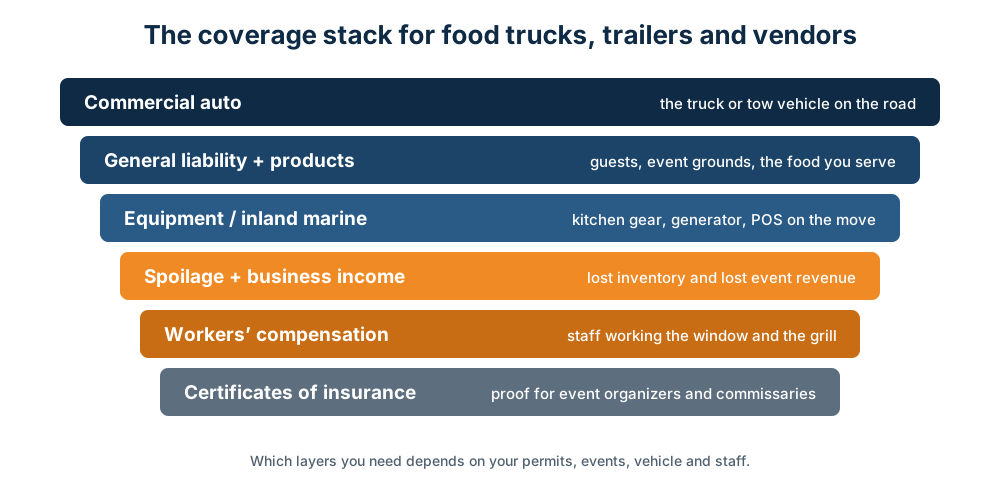
Food trucks in South Carolina typically need commercial auto on the truck (the state minimum is 25/50/25 plus matching uninsured motorist), general liability with additional insured endorsements for festivals and private events, inland marine or equipment coverage for the kitchen built into the vehicle, and workers’ compensation once four or more people work for the business. A personal auto policy will not cover a working food truck.
This guide is for food truck and trailer operators working breweries, office parks, beach towns and festivals from Greenville to Myrtle Beach and Hilton Head. It explains how the state’s mobile food rules interact with insurance and where the real claims come from.
SCDA mobile permits, commissaries and auto minimums
Mobile food units are permitted by the South Carolina Department of Agriculture’s Retail Food Safety program through a Mobile Food Establishment supplemental application. Every unit must be supported by a permitted commissary, the base kitchen where you restock, clean and dispose of waste. Units that sell potentially hazardous or time and temperature controlled foods, such as barbecue, wings or fried fish, must be fully enclosed. A pull-behind cooker on its own does not qualify as a mobile unit, which matters when you describe your operation to an underwriter.
Like every retail food establishment, a truck needs at least one certified food protection manager with authority over preparation and service. On the road, South Carolina requires auto liability of at least 25/50/25 (in thousands of dollars) and uninsured motorist coverage at the same limits. Festival organizers, municipalities and private venues typically require much higher liability limits on the certificate and ask to be named as additional insured.
Workers’ comp applies once you regularly employ four or more people in South Carolina, part-time and family help included. A two-person truck may be exempt, but adding weekend staff for event season can push you over. See the South Carolina restaurant workers’ comp guide for the details.
Risks that come with a kitchen on wheels
Propane is the headline exposure. A loose fitting on a cylinder connection leaks during a downtown street festival, a burner ignites it, and the flash burns a cook and scorches a neighboring vendor’s tent. That is a mix of workers’ comp, general liability for the neighbor’s property, and physical damage to your own truck, each from a different part of the program.
Driving is the everyday risk. A heavy truck with a full water tank takes longer to stop, and a fender-bender pulling out of a brewery lot in Rock Hill becomes a commercial auto claim. Tight venue setups mean backing into bollards, light poles and other vendors’ trailers. Generators and extension cords create trip hazards in the customer line, and a child reaching for a service window can be burned by a hot surface.
Weather is a coastal wildcard. A truck parked at a commissary on James Island during a tropical storm can take flood or wind damage, which is handled by comprehensive coverage on the auto policy, while the kitchen equipment installed inside may need its own valuation. And if the commissary’s walk-in fails overnight, the brisket and slaw prepped for a Saturday wedding are gone, which is a spoilage claim.
What a South Carolina food truck policy should include
- Commercial auto liability — required for the truck or tow vehicle, ideally well above the 25/50/25 minimum.
- Physical damage (comprehensive and collision) — pays to repair or replace the truck after a crash, storm or theft.
- General liability — covers customer injuries at the service window and damage to venue property.
- Products-completed operations — responds to foodborne illness or allergen claims from what you serve.
- Additional insured endorsements — satisfy festival, municipal and venue requirements for certificates.
- Inland marine or equipment coverage — protects fryers, smokers, griddles and refrigeration built into the unit.
- Spoilage — replaces product lost to a commissary or on-board refrigeration failure.
- Workers’ compensation — required once four or more people regularly work for you.
Why two food trucks pay different premiums
Carriers price a truck on its value and age, the driver’s record, how many miles you run and how far you travel between events, where it is parked overnight, the cooking method (fryers and open-flame smokers rate differently than a cold sandwich menu), fuel type, annual sales and the number of events you work. Coastal garaging can affect physical damage pricing.
Owners who get stronger options usually keep propane inspections current, mount a Class K extinguisher near the fry station, secure generators and cable covers, store the truck in a fenced or lighted lot, and restrict driving to a short list of experienced employees with clean records.
Quotes, certificates and event season
Provident Financial Group uses one application to shop multiple carriers quoted through our agency and shows you the options side by side. Food truck owners need certificates for nearly every event, so we set you up to request them quickly, with the additional insured wording each organizer asks for. Call (866) 964-6660 before event season starts.
Frequently asked questions
Can I use personal auto insurance for my South Carolina food truck?
No. A vehicle used as a business kitchen needs commercial auto; personal policies generally exclude this kind of business use.
Does a pull-behind smoker count as a mobile food unit?
Not by itself under SCDA guidance for units selling TCS foods, which must be fully enclosed. Tell us your exact setup so the policy describes it correctly.
How fast can I get a certificate for a festival?
Once coverage is bound, usually quickly. Send us the organizer’s requirements and we will issue the certificate with the right endorsements.
Does my commissary lease require separate coverage?
Many commissary agreements require liability limits and additional insured status. We can review the agreement and match it.
Rolling into a new season? Get Multiple Quotes within minutes.