
Bars and taverns in Delaware typically need general liability, liquor liability, workers’ compensation from the first employee, and commercial property with business interruption. Delaware courts do not recognize a dram shop cause of action, but liquor liability still matters: on-premises incidents, defense costs and lease or lender requirements all create exposure, and a standard general liability policy usually excludes alcohol-related claims for businesses that serve drinks.
This page is written for owners of neighborhood taverns in Wilmington, college bars in Newark, pubs in Dover and the seasonal bars that fill up along Rehoboth and Dewey Beach each summer. If you hold, or are applying for, an on-premises license from the Office of the Delaware Alcoholic Beverage Control Commissioner (OABCC), here is how the state’s rules translate into an insurance program. For the national overview, see our bar and tavern insurance guide; for every restaurant type in the state, start at the Delaware restaurant insurance hub.
Delaware law and the tavern owner: what actually applies
The headline fact is the 1994 Delaware Supreme Court decision in McCall v. Villa Pizza, Inc. The court held there is no statutory or common-law cause of action against a tavern by a patron or a third party injured off the premises by an intoxicated patron, and it left any change to the General Assembly. That sets Delaware apart from neighboring Pennsylvania and Maryland when it comes to third-party liquor claims.
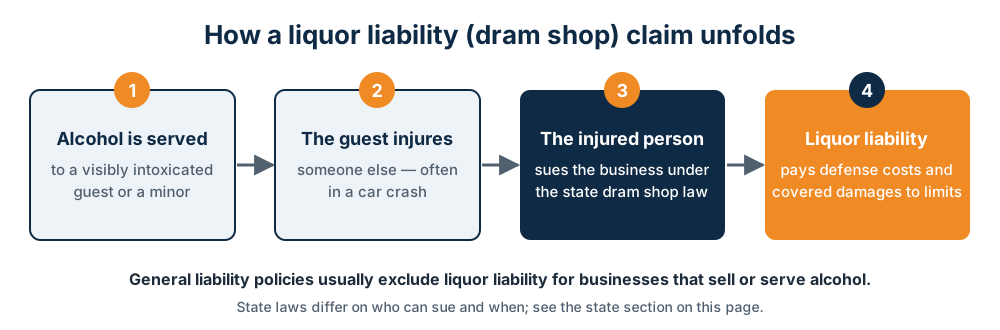
It does not make liquor liability optional in practice. The ruling speaks to injuries away from your premises; a fight at the rail, an intoxicated guest who tumbles down your stairs, or a lawsuit that tries a new legal theory still has to be answered, and defense costs arrive whether or not the claim ultimately succeeds. Landlords and lenders frequently require liquor liability regardless of state law, and because the court deferred to the legislature, the rule could change. Most general liability forms also exclude liquor-related claims for businesses that sell or serve alcohol, so without a separate liquor policy there may be nothing responding at all. Our Delaware liquor liability page goes deeper.
Delaware also mandates Responsible Alcoholic Beverage Server Training. Under 4 Del. C. § 1203, employees who sell, serve or dispense alcohol, and their managers, must complete a state-approved course, and certification is valid for two years (§ 1205). The Commissioner can fine licensees, bar untrained employees from serving and suspend or revoke server cards (§ 1206), with enforcement handled by the Division of Alcohol and Tobacco Enforcement. Workers’ compensation is required as soon as you have one employee (19 Del. C. § 2306), which covers essentially every bar with a bartender, barback or door staff.
Where Delaware bar claims come from
A Saturday crowd at a Newark college bar spills onto a wet patio and a guest breaks a wrist on the step: a classic premises claim for general liability. A doorman walks an unruly patron outside and the patron alleges excessive force; whether that is covered depends on the assault and battery wording, which many bar policies limit or exclude. A barback muscling half-barrels in the walk-in strains his back and misses six weeks, and a bartender slices a thumb on a broken pint glass while clearing a bus tub. Both are workers’ comp claims, and both are routine in the trade.
Property losses hurt too. A beach-town tavern in Sussex County faces tropical storms, nor’easters and flooding in low-lying areas, and inland spots in Kent County see riverine flooding and winter storms. A flooded cellar full of beer and liquor stock, or a storm outage that spoils the coolers during a July weekend, can wipe out the weeks that carry the whole year. Standard property forms typically exclude flood, so coastal bars should ask about separate flood coverage.
Coverage checklist for a Delaware tavern
- Liquor liability — responds to alcohol-related injury claims that general liability typically excludes for licensees, and pays defense costs even when a claim is weak under McCall.
- General liability — slips on spilled drinks, trips on patio steps and other guest injuries not tied to intoxication.
- Assault and battery coverage — confirm it is included or added back; security incidents are a core bar exposure.
- Workers’ compensation — required from the first employee; responds to glass cuts, keg-lifting strains and falls behind the bar.
- Commercial property — building if owned, bar equipment, furniture, POS hardware and liquor inventory.
- Business interruption — lost income after a covered fire or storm closes the doors, critical for seasonal shore bars.
- Equipment breakdown and spoilage — draft systems, ice machines and walk-in coolers.
- Employment practices liability — harassment, wrongful termination and wage allegations from a high-turnover staff.
- Umbrella — extra limits above general liability and, where scheduled, liquor and auto, for landlords who ask for more.
What moves a bar’s premium up or down
Carriers price bars on the share of revenue from alcohol, closing time, occupancy, entertainment such as live bands or DJs, whether there is a dance floor, security staffing, prior claims and the building’s construction and fire protection. For workers’ comp, payroll by classification under the Delaware Compensation Rating Bureau (DCRB) system drives cost; Delaware maintains its own classifications rather than using NCCI’s.
To improve pricing, document server training for every bartender and manager and calendar the two-year renewals, use ID scanners, keep incident logs and camera footage, put a written cut-off policy in the employee handbook, and keep kitchen sales visible. A meaningful food share often reads as a lower-risk account to underwriters.
Quoting a Delaware bar through an independent agency
Provident Financial Group is an independent agency, so one application goes to multiple carriers and we compare liquor limits, assault and battery wording and exclusions side by side, not just the bottom line. Once coverage is bound you can pull live certificates of insurance for your landlord, lender or an event promoter. Call (866) 964-6660 or start online.
Frequently asked questions
If Delaware has no dram shop law, can I skip liquor liability?
It is usually not advisable. General liability typically excludes alcohol-related claims for licensees, landlords and lenders commonly require liquor coverage, and defense costs apply even to claims that ultimately fail.
How often do Delaware bartenders need server training?
Certification under 4 Del. C. ch. 12 is valid for two years, and both servers and their managers must be trained. The Commissioner can fine the licensee and bar untrained employees from serving.
Do part-time bar employees count for workers’ comp?
Yes. Delaware requires coverage once you have one employee, and part-timers are employees. Sole proprietors and partners are excluded but may elect coverage.
Will my bar policy pay for a fight involving my doorman?
Only if assault and battery coverage is included. Many bar policies exclude or sublimit it, so check the wording before you bind.
Want to see how several carriers view your tavern? Get Multiple Quotes within minutes. Or call (866) 964-6660.