
A Franchise Disclosure Document and its franchise agreement usually require a restaurant franchisee to carry general liability, property and business income, workers’ compensation, auto or hired and non-owned auto, umbrella and often liquor, EPLI and cyber coverage, at stated minimum limits. Most also require the franchisor and its affiliates as additional insureds, primary and non-contributory wording, waivers of subrogation, rated carriers and certificates before opening.
This checklist is for owners about to sign a franchise agreement, building out a first unit or answering a compliance notice. It shows where the insurance terms sit in the FDD and how to match them to a quote so your certificate is accepted the first time. It is the review Provident Financial Group runs on every franchisee’s documents, and it pairs with our franchise restaurant insurance guide.
Where do insurance requirements live in an FDD?
The FDD has 23 items required by the FTC Franchise Rule (16 CFR Part 436), and insurance shows up in several:
- Item 9 (Franchisee’s Obligations) — a cross-reference table with an “Insurance” row pointing to the agreement and manual sections that hold the real requirements.
- Item 8 (Restrictions on Sources of Products and Services) — discloses what you must buy from the franchisor or designated or approved suppliers. Some systems name an approved insurance program here.
- Item 6 (Other Fees) — often lists what you owe if the franchisor buys insurance for you after you fail to.
- Item 7 (Estimated Initial Investment) — many franchisors include an insurance line. Treat it as a placeholder, not a quote.
- The franchise agreement itself — usually an insurance section or exhibit listing required lines, limits, endorsements and certificate rules. Your certificate is checked against this language.
Most agreements also let the franchisor change insurance standards through the operations manual on notice, so ask for the current standards, not just the version printed in your FDD.
Does Item 8 limit which insurance company you can use?
Usually not outright. Most systems set minimum standards and let you buy from any carrier that meets the rating requirement. Some recommend a preferred program without requiring it. A smaller group designates an approved program and requires written approval for anything else.
Item 8 must also disclose whether the franchisor earns revenue from required purchases, which tells you if it has a financial interest in where you place coverage. Either way, compare an outside quote against the program; an independent agency can show you both side by side.
Which lines of coverage do franchise agreements usually require?
Requirements vary by brand, but a restaurant franchise agreement typically calls for most of these:
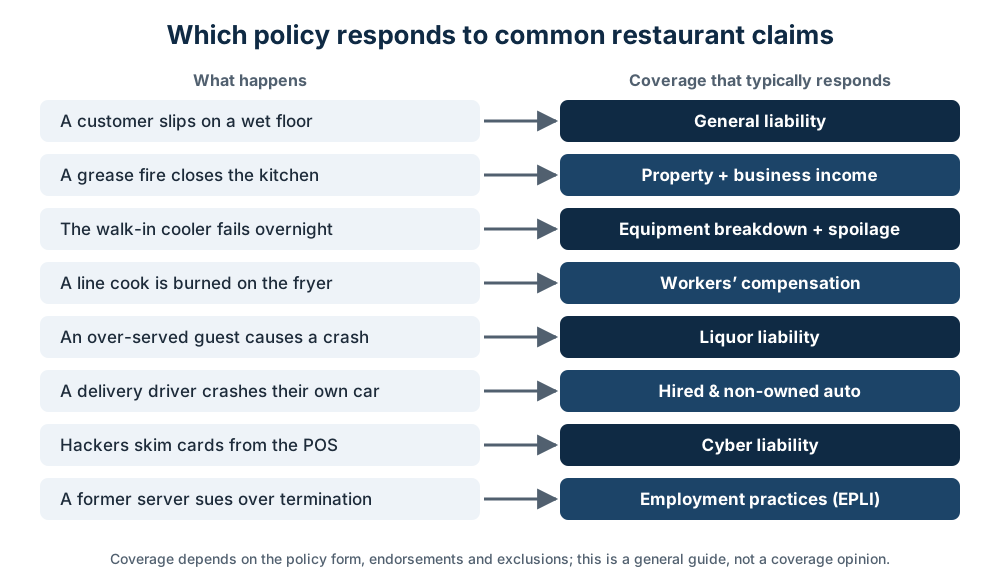
- Commercial general liability — occurrence-form coverage for bodily injury, property damage and products-completed operations, commonly with minimums of $1 million per occurrence and $2 million aggregate, often with the aggregate required to apply per location. Franchisors get named in slip-and-fall and foodborne-illness suits because their sign is on the building.
- Liquor liability — required if you serve alcohol, at the agreement’s limit. Host liquor inside a GL policy usually does not satisfy it; see liquor liability laws by state.
- Commercial property — replacement cost on equipment, furniture, brand-required signage and your tenant improvements and betterments, so the unit is rebuilt to brand standard after a fire.
- Business income and extra expense — often required for a minimum period so royalties and payroll continue during a shutdown, measured as a period of indemnity.
- Workers’ compensation and employer’s liability — statutory coverage plus employer’s liability at stated limits, often required even where the state would let a small employer opt out.
- Commercial auto or hired and non-owned auto — owned auto if the business owns vehicles; HNOA if staff drive their own cars for deliveries or supply runs.
- Umbrella or excess liability — sits over GL, employer’s liability, auto and sometimes liquor to reach the brand’s total limit; our umbrella vs. excess comparison covers the difference.
- Employment practices liability (EPLI) — increasingly common, because harassment and discrimination suits often name the brand as a joint employer.
- Cyber liability — more systems require it because units share point-of-sale and online ordering platforms, so one breach can become a brand-wide problem.
Some agreements add food contamination, crime or builder’s risk during construction. Never assume a package policy includes a line the agreement names.
How should the franchisor be named as an additional insured?
This is where most certificates get rejected. Agreements typically require the franchisor and its parent, subsidiaries and affiliates, plus their officers, directors and employees. A certificate listing only one entity, or a trade name instead of the legal name, usually comes back.
Check three things: the exact entity wording to copy, whether coverage must include ongoing and completed operations, and whether a blanket endorsement is acceptable or a scheduled one is required. Our explainer on the additional insured endorsement goes deeper; your landlord’s demand can usually sit on the same policy.
What do primary and non-contributory and a waiver of subrogation do?
Picture a guest who slips on a wet floor near the drink station and sues both your company and the franchisor. Primary and non-contributory wording means your policy responds first and does not ask the franchisor’s own insurer to share the cost.
A waiver of subrogation stops your insurer from paying your claim and then suing the franchisor to recover. Say a kitchen fire is traced to a hood design the franchisor specified: without the waiver, your property carrier could pay you and then pursue the brand. Agreements commonly require it on GL, workers’ comp, property and umbrella. Read more on the waiver of subrogation for restaurants.
Carrier ratings, cancellation notice and deductible caps
Minimum carrier rating. Most agreements require insurers to hold a minimum financial strength rating from an independent rating agency, often with a minimum size category, and some require admitted carriers only. A good policy from a carrier below the brand’s floor is still non-compliant, so check before you bind.
Notice of cancellation. Agreements often require advance written notice to the franchisor before cancellation. Standard forms notify only the named insured, so this usually takes a third-party notice endorsement; certificate wording alone does not create it.
Deductible and self-insured retention caps. Many agreements cap deductibles or retentions. Raising a deductible is a common pricing lever, so confirm the cap first.
When are certificates of insurance due?
Typical triggers: before construction or possession of the site, before opening, at every renewal and within a set number of days of any request. Renewal certificates generally must arrive before expiration; a late one looks like a lapse even if you renewed on time.
Many brands use compliance platforms that flag mismatched names, dates and endorsements automatically. Our restaurant certificate of insurance page and the restaurant COI checklist help before you send.
What happens if you fall out of compliance?
Missing required insurance is typically a default: written notice, a cure period and, if unresolved, remedies that can escalate toward termination. Gaps can also stall an opening or a transfer.
Many agreements also let the franchisor buy the missing coverage and charge you, often plus an administrative fee. This is common but not universal. Such coverage mainly protects the franchisor and is rarely priced in your favor, and most gaps are endorsement-level fixes you can make yourself.
How do you reconcile the FDD with an insurance quote?
- Pull the current standards: agreement section or exhibit, Item 9 and manual updates.
- List each required line and minimum limit.
- Copy the additional insured, primary and non-contributory, waiver and notice wording.
- Note the rating floor and deductible caps.
- Compare each quote line by line, including endorsement forms.
- Close gaps before binding with endorsements, limit changes or an umbrella.
- Draft the certificate against the agreement wording.
Running several units? See multi-unit franchise insurance and franchise restaurant insurance cost factors.
FDD insurance checklist at a glance
| Requirement | What to look for | Common pitfall |
|---|---|---|
| General liability limits | Per occurrence and aggregate minimums; per-location aggregate | One shared aggregate across several units |
| Liquor liability | Stand-alone limit at or above the agreement minimum | Relying on host liquor inside the GL policy |
| Property and business income | Replacement cost, signage, improvements, period of indemnity | Actual cash value or too short a restoration period |
| Workers’ comp and employer’s liability | Statutory WC plus stated EL limits | Owners excluded when the brand requires them covered |
| Auto or HNOA | Owned auto if you own vehicles; HNOA for employee driving | No HNOA while staff run errands in personal cars |
| Umbrella or excess | Total limit, underlying policies scheduled, follow form | Liquor or EL not scheduled under the umbrella |
| EPLI and cyber | Whether required, minimum limits, franchisor as insured | Assuming the package policy includes them |
| Additional insured | Franchisor, parent, affiliates, officers, employees | Trade name used instead of legal entity names |
| Primary and non-contributory | Endorsement language, not just a certificate note | Wording typed on the certificate with no endorsement |
| Waiver of subrogation | Required lines: GL, WC, property, umbrella | Waiver added to GL only |
| Carrier rating | Rating agency, minimum rating and size, admitted status | Binding with a carrier below the brand’s floor |
| Notice of cancellation | Advance written notice to franchisor | No notice endorsement behind the certificate |
| Deductible caps | Maximum deductible or retention per line | Raising a deductible past the cap to trim pricing |
| Certificate timing | Before lease, opening, each renewal, on request | Renewal certificate sent after expiration |
Frequently asked questions
Where in the FDD do I find the insurance requirements?
Start with Item 9’s insurance row, which points to the governing section of the franchise agreement or its insurance exhibit.
Can I use my own insurance agent instead of the franchisor’s program?
In most systems, yes, if the policy meets every written standard. If Item 8 designates an approved program, get written approval first.
Why was my certificate rejected when my coverage is correct?
Usually incomplete additional insured names, missing endorsements, an expired date or a carrier below the required rating.
Can a franchisor buy insurance for me and send me the bill?
Many agreements allow it when you fail to maintain coverage, but not all; check your agreement and Item 6.
Do franchise insurance requirements change after I sign?
They can, through operations manual updates, so review the current standards before each renewal.
Send us your FDD insurance section and certificates; we will reconcile them, compare multiple carriers and show what you qualify for. Call (866) 964-6660 or Get Multiple Quotes within minutes.