
Michigan requires retail liquor licensees to prove at least $50,000 of dram shop financial responsibility under MCL 436.1803, and most meet it with liquor liability insurance. Under the dram shop act, MCL 436.1801, people injured because a licensee unlawfully served a minor or a visibly intoxicated person can sue, subject to strict notice, name-and-retain and two-year filing rules.
This page is for Michigan on-premises licensees: sports bars near the stadiums in Detroit, game-day taverns in Ann Arbor, brewpubs, supper clubs up north and caterers with bar service. The Michigan Liquor Control Commission (MLCC), part of the Department of Licensing and Regulatory Affairs, licenses and disciplines you; the dram shop act decides when you pay.
Who can sue under MCL 436.1801, and what must they prove?
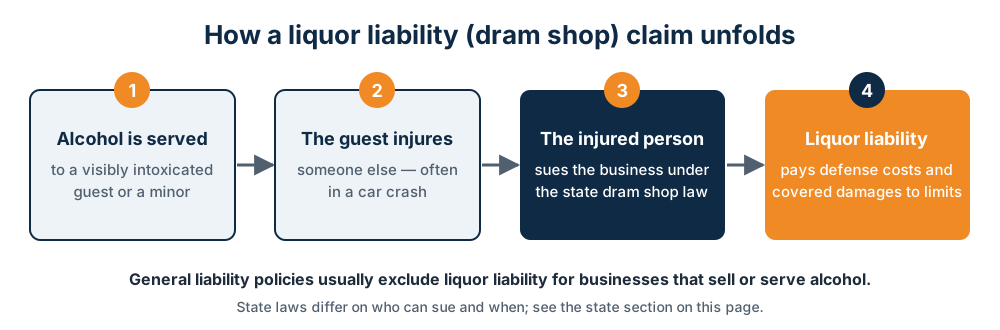
A person injured because a retail licensee unlawfully sold, gave or furnished alcohol to a minor or to a visibly intoxicated person can sue that licensee. Visibly intoxicated is the key phrase: the question is what a server could see, such as slurred speech, stumbling or glassy eyes, not what a blood test later shows. For minors, the unlawful sale itself is the trigger. Michigan sets no statutory cap on damages.
The procedural rules that shape every Michigan case
- 120-day written notice — the plaintiff must give written notice within 120 days of hiring an attorney
- Name and retain — the minor or intoxicated person must be named as a defendant and kept in the suit, so the drinker cannot quietly settle out and leave the bar holding the claim
- Last-server presumption — licensees other than the last one to serve are presumed not liable, a presumption the plaintiff can try to rebut
- Two-year limit — dram shop suits must be filed within two years
These rules give licensees real defenses, but only if records back them up. Receipts with timestamps, a note of who was cut off, and video that shows a patron’s condition at last call are what your defense lawyer will ask for first.
Legally required, not just contractually required
Michigan is one of the few states where the coverage is effectively a license condition. MCL 436.1803 requires retail licensees to show proof of financial responsibility of at least $50,000 for dram shop liability. You can meet it with liquor liability insurance, cash, unencumbered securities, a surety bond or membership in a group self-insurance pool; special (temporary) licensees are exempt. Treat that figure as a floor, not a recommendation. Landlords, lenders and event venues typically require far higher limits and additional insured status.
Server training under MCL 436.1906
Training is mandatory for many on-premises licensees. New on-premises licensees, anyone acquiring more than 50 percent interest in a license, and licensees the commission orders to comply after violations must have server-trained supervisory personnel on the premises on every shift whenever alcohol is served, using a commission-approved program. The statute also creates a responsible vendor designation for licensees that train all employees and stay violation-free; its specific legal effect is unverified, but carriers treat full-staff training as a strong signal.
Social host rules, and why BYOB is off the table
MCL 750.141a makes it a misdemeanor for someone controlling premises to knowingly allow a minor to drink or possess alcohol at a social gathering, and MCL 436.1701 bars furnishing alcohol to minors. Social hosts may face civil liability for furnishing to minors; liability for serving adults is unverified. For restaurants, the bigger rule is MCL 436.1913(2): a food business without a liquor license cannot allow customers to drink on site, so unlicensed restaurants cannot offer BYOB. Private events with no charge to guests at unlicensed facilities are an exception, enforced by local police rather than the MLCC.
Claim scenarios Michigan venues see
| Scenario | Key Michigan issue | What protects you |
|---|---|---|
| Fans leave a downtown sports bar after a night game and one causes a crash on the freeway | Was he visibly intoxicated when last served, and were you the last server? | Liquor liability; timestamped receipts support the last-server presumption |
| A student with a fake ID is served at a campus-area tavern | Sale to a minor is the trigger | Liquor liability; ID scanners; MLCC exposure |
| A patron leaves a northern supper club into lake-effect snow and slides into oncoming traffic | Service decisions judged against visible signs at the bar | Liquor liability; ride-home policy |
| A bouncer is injured breaking up a fight | Employee injury, not dram shop | Workers’ compensation |
Michigan requires workers’ comp for employers with three or more employees, or fewer if one has worked 35 or more hours a week for 13 weeks in the past year. See restaurant workers’ comp in Michigan.
Assault and battery and the GL liquor exclusion
Your general liability policy excludes liquor-related injury once you are in the business of selling alcohol, which is why this is a separate policy. Within the liquor policy, check assault and battery: exclusions and low sublimits are common, and claims arising from your own security staff are sometimes carved out. More in does liquor liability cover assault claims?
Per-occurrence and aggregate limits
The per-occurrence limit caps one incident; the aggregate caps the policy year. Because Michigan has no damage cap, the per-occurrence limit and an umbrella that follows form over liquor matter more than the statutory minimum. See per-occurrence vs. aggregate.
Michigan coverage checklist
- Liquor liability meeting MCL 436.1803 — needed to hold a retail license
- Limits well above the statutory floor — leases and verdicts do not stop at the minimum
- Assault and battery at full limits — crowd and ejection claims
- Defense outside the limit where available — protects the limit you bought
- Employees as insureds — servers are named in suits
- Additional insured endorsements — landlords and venues require them
- Workers’ compensation — for door staff and bartenders
How alcohol sales set your premium
Carriers usually rate on annual liquor receipts, then weigh the alcohol-to-food ratio, closing time, entertainment, occupancy, security, MLCC violations and claims history. A brewpub selling mostly food rates very differently from a late-night bar. Full-staff training, ID scanning and documented cut-offs help.
Which Michigan businesses face which issues
Bars face the most visibly-intoxicated claims. Breweries add product liability. Caterers must confirm who holds the license at each event. Fine dining rooms still need proof of financial responsibility even with modest bar sales.
How quoting works with Provident Financial Group
One application goes to multiple carriers, and we compare limits, assault and battery terms and defense treatment side by side. Once bound, you get proof of coverage for the MLCC and certificates for landlords. Call (866) 964-6660. For the full package, see restaurant insurance in Michigan.
Frequently asked questions
Is liquor liability insurance mandatory in Michigan?
Retail licensees must prove at least $50,000 of dram shop financial responsibility under MCL 436.1803. Insurance is the usual way; cash, securities, a surety bond or a group self-insurance pool also qualify.
What is the name-and-retain rule?
The plaintiff must name the minor or intoxicated person in the suit and keep them in it. The drinker cannot settle out and leave the bar alone as the defendant.
How long does someone have to file a dram shop suit in Michigan?
Two years, and written notice is due within 120 days of hiring an attorney.
Can my unlicensed restaurant allow BYOB?
No. MCL 436.1913(2) bars food businesses without a liquor license from allowing on-site drinking, except no-charge private events.
Ready to compare Michigan liquor coverage? Get Multiple Quotes within minutes.
Official Michigan sources
- Michigan Compiled Laws § 436.1801 (dram shop liability)
- Michigan Compiled Laws § 436.1803 (licensee proof of financial responsibility)
- Michigan Compiled Laws § 436.1906 (server training)
- Michigan Compiled Laws § 436.1701 (furnishing alcohol to minors)
- Michigan Liquor Control Commission: consumption on unlicensed premises
State facts on this page are drawn from the statutes and agency pages above. Laws and agency rules change, so confirm current requirements with the agency before relying on them. This page is general information, not legal advice or a coverage opinion.
Related pages
- Restaurant insurance in Michigan
- Bar insurance in Michigan
- Brewery insurance in Michigan
- Catering insurance in Michigan
- Fine dining insurance in Michigan
- Restaurant insurance in Grand Rapids
- Liquor liability laws by state