
Ohio bars and restaurants need liquor liability insurance because general liability excludes alcohol claims and Ohio Rev. Code 4399.18 still allows suits against permit holders. On the premises or parking lot, ordinary negligence applies; for off-premises injuries, the plaintiff must prove you knowingly sold to a noticeably intoxicated or underage person. Ohio does not require the coverage by statute.
This guide is for Ohio permit holders: game-day bars near campus in Columbus, neighborhood taverns and brewpubs in Cleveland, riverfront restaurants and caterers statewide. Three agencies touch your license: the Ohio Department of Commerce, Division of Liquor Control issues and renews permits; the Ohio Investigative Unit (Department of Public Safety) enforces; and the Ohio Liquor Control Commission hears violations and appeals.
Two standards under Ohio Rev. Code 4399.18
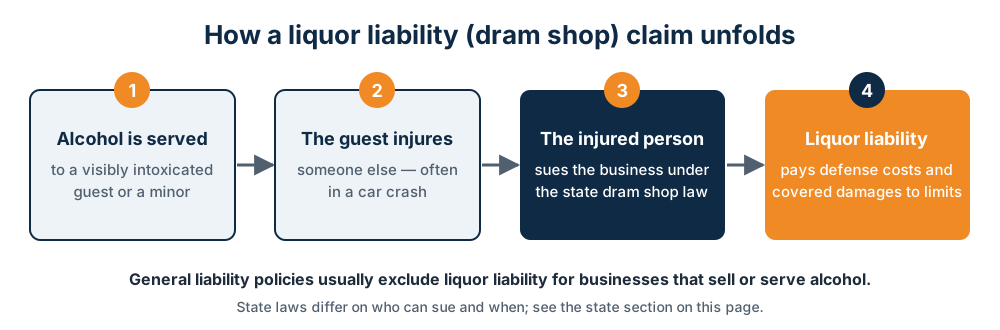
Ohio’s dram shop statute splits claims by where the injury happens, and the difference is large.
| Where the injury happens | What the plaintiff must show | Example |
|---|---|---|
| Inside the premises or in your parking lot | The harm resulted from your or your employees’ negligence | An intoxicated guest shoves another patron down the patio steps |
| Off premises | You knowingly sold to a noticeably intoxicated person or an underage person, and the intoxication proximately caused the harm | A patron leaves after last call and causes a crash across town |
| Injury on leased premises, claim against the building owner | No liability for a landlord leasing to a permit holder, unless they are the same person | The strip-center owner is dismissed; the bar remains |
Knowingly is a real hurdle for off-premises plaintiffs, and it is why so much Ohio litigation turns on what staff actually saw and did. There is no statutory damage cap, and the negligence standard for anything that happens in your building or lot means fights, falls and ejections are easier claims to bring than the classic drunk-driving case.
Why your parking lot is part of the premises
Because 4399.18 reaches the parking lot under the negligence standard, lighting, security patrols and how staff handle a guest they have cut off all matter. A fight that spills outside at closing, or a guest who falls in an icy lot during a lake-effect storm, is judged by ordinary negligence, not the tougher knowingly test.
Social host rules and Ohio Rev. Code 4301.69
No Ohio statute imposes dram-shop-style civil liability on social hosts; 4399.18 applies to permit holders. Ohio Rev. Code 4301.69 criminally prohibits furnishing alcohol to underage persons and bars owners or occupants of any public or private place from knowingly allowing underage persons to drink there, with a parent or guardian exception. The scope of civil social host liability under case law is unverified.
Does Ohio require liquor liability insurance?
No statute requires on-premises permit holders to carry liquor liability insurance or prove financial responsibility. The requirement arrives by contract. Interestingly, 4399.18 already shields landlords who lease to permit holders, yet most Ohio commercial leases still require the tenant to carry liquor coverage and name the landlord as additional insured, and lenders, franchisors and event venues ask for the same.
The ASK program and voluntary server training
Server training is voluntary in Ohio. The Ohio Investigative Unit offers the Alcohol Server Knowledge (ASK) program on permit rules and responsibilities at no charge. No statutory mandate or safe harbor was found. Because off-premises cases turn on whether staff knowingly served a noticeably intoxicated guest, ASK attendance, cut-off logs and incident reports are practical evidence, and underwriters notice them.
BYOB rules for permit holders and unpermitted restaurants
A permit holder may not allow open containers of alcohol that were not purchased from it. A business without a permit that allows BYOB and charges corkage, cup, storage or similar fees risks illegal-sale violations. The OIU says BYOB may be allowed at truly private events with no fees and no alcohol sales, decided case by case. See do BYOB restaurants need liquor liability?
The workers’ comp gap Ohio bars must close
When a bouncer is hurt in a fight, Ohio is different. Workers’ comp is sold only through the Ohio Bureau of Workers’ Compensation, a monopolistic state fund, and it does not include employer’s liability the way a private policy does. Ohio employers commonly add stop-gap employer’s liability, though even that coverage has limits for employer intentional-tort claims, which under Ohio Rev. Code 2745.01 require proof of intent to injure. See restaurant workers’ comp in Ohio.
Assault and battery, and the GL liquor exclusion
A GL policy excludes intoxication-related injury once you sell alcohol, so liquor liability is separate. Inside it, assault and battery is often excluded or sublimited, and injuries caused by your own security staff may be carved out. Given the on-premises negligence standard, confirm fights are covered at full limits; see does liquor liability cover assault claims?
Setting per-occurrence and aggregate limits
The per-occurrence limit caps one incident and the aggregate caps the policy year. A busy game-day bar can see several separate incidents in a season, so the aggregate matters as much as the per-occurrence figure. Ask whether defense erodes limits and whether your umbrella follows form over liquor. More on per-occurrence vs. aggregate.
Ohio coverage checklist
- Liquor liability — answers 4399.18 suits your GL excludes
- Assault and battery at full limits — on-premises fights face only a negligence standard
- Parking lot included — the statute treats it as premises
- Stop-gap employer’s liability — fills the gap in Ohio BWC coverage
- Additional insured endorsements — leases still demand them
- Defense outside the limit where available
- Umbrella that follows form over liquor — no statutory cap
What drives Ohio liquor pricing
Carriers rate largely on annual alcohol receipts and alcohol’s share of sales, then weigh closing time, entertainment, occupancy, security, OIU violations and prior claims. A family restaurant with a beer list and a late-night campus bar sit far apart. ASK training, ID scanners and parking lot lighting all help.
Which Ohio businesses face which issues
Bars carry the most on-premises fight exposure. Breweries add product liability. Caterers must know whose permit covers each event. Fine dining rooms face over-service claims after long wine dinners.
How quoting works with Provident Financial Group
One application goes to multiple carriers, and Provident Financial Group compares liquor terms, assault and battery wording and stop-gap options side by side. After binding we issue certificates for landlords and venues. Call (866) 964-6660. See restaurant insurance in Ohio.
Frequently asked questions
What does an Ohio plaintiff have to prove for an off-premises crash?
That you knowingly sold to a noticeably intoxicated or underage person and the intoxication proximately caused the harm (Ohio Rev. Code 4399.18).
Is my parking lot covered by the easier negligence standard?
Yes. The statute treats injuries on the premises or in the parking lot under ordinary negligence.
Can my Ohio restaurant allow BYOB?
A permit holder cannot allow alcohol not bought from it. Unpermitted businesses risk violations if they charge any BYOB-related fee.
Why do I need stop-gap coverage in Ohio?
Ohio BWC coverage does not include employer’s liability, so stop-gap fills that gap for employee injury suits.
Compare Ohio liquor coverage now. Get Multiple Quotes within minutes.
Official Ohio sources
- Ohio Revised Code § 4399.18 (liquor permit holder liability)
- Ohio Division of Liquor Control: Alcohol Server Knowledge program
- Ohio Liquor Control Commission: about
- Ohio Revised Code § 4301.69 (furnishing alcohol to underage persons)
- Ohio Investigative Unit: Alcohol Server Knowledge (ASK) program
- Ohio Investigative Unit: establishments and bring-your-own beverages
State facts on this page are drawn from the statutes and agency pages above. Laws and agency rules change, so confirm current requirements with the agency before relying on them. This page is general information, not legal advice or a coverage opinion.
Related pages
- Restaurant insurance in Ohio
- Bar insurance in Ohio
- Brewery insurance in Ohio
- Catering insurance in Ohio
- Fine dining insurance in Ohio
- Restaurant insurance in Cincinnati
- Liquor liability laws by state