
California liquor liability insurance covers bodily injury and property damage claims tied to alcohol you sell or serve. California’s dram shop law is among the narrowest in the country: Business and Professions Code §25602 shields sellers from most over-service suits, but §25602.1 allows claims when an obviously intoxicated person under 21 is served. We found no statewide insurance mandate, but leases, lenders and permits usually require it.
This page is for California bars, brewery taprooms, restaurants with a serious bar program and caterers who pour at events. It explains what the law exposes you to, where coverage gaps hide and how carriers price your operation. For the rest of your program, start with restaurant insurance in California.
What does California’s dram shop law actually say?
California starts from the opposite end from most states. Under Business and Professions Code §25602(b), a person who sells or furnishes alcohol to an obviously intoxicated person is not civilly liable for injuries caused by the drinker’s intoxication, and Civil Code §1714(b) declares that consuming the alcohol, not serving it, is the proximate cause. When an adult guest drinks too much and later causes a crash, a classic dram shop suit against your bar generally fails.
The exception is where California venues get hurt. B&P §25602.1 lets an injured person sue a licensee, or anyone required to hold a license, who sells or furnishes alcohol to an obviously intoxicated person under 21 when that intoxication causes injury or death (the jury instruction is CACI 422). The test is obvious intoxication plus the guest’s age, so one missed ID check on a busy Friday reopens the exposure the statute otherwise closes. We did not identify any statutory damage cap on these claims.
The Department of Alcoholic Beverage Control (ABC) also notes that licensees still owe patrons ordinary common-law care, which is where security failures, fights and falls involving intoxicated guests come in.
Social hosts, private parties and the under-21 rule
Civil Code §1714(c) says a social host who furnishes alcohol is not liable to the drinker or to anyone the drinker injures. Section 1714(d) carves out one situation: a parent, guardian or other adult who knowingly furnishes alcohol at his or her residence to someone known, or who should have been known, to be under 21. Either the minor or a person the minor harms can bring that claim. The minor-service exception runs through both the licensee rule and the host rule, so underage service is the thread to control. If you book buyouts or private parties, see how liquor liability differs from host liquor liability.
Is liquor liability insurance legally required in California?
We did not find a statewide statutory requirement in the ABC materials we reviewed, and that point is unverified, so confirm it for your license type. In practice the requirement comes from contracts: commercial landlords write liquor liability into the lease, lenders and equipment financiers require it, special event permits often call for it, and some cities attach it to a conditional-use permit for late-night or entertainment venues. Expect to show a certificate of insurance naming the landlord or venue as additional insured.
Responsible Beverage Service training and BYOB limits
Server training is mandatory. California’s Responsible Beverage Service (RBS) law (AB 1221 and AB 82; 4 CCR §§160–173) requires servers and their managers at on-premises ABC licensees to be certified. A server is anyone who checks ID, takes alcohol orders, pours or delivers alcohol; a manager is anyone who trains, hires or oversees servers. Staff must certify within 60 days of hire by passing a 50-question exam with a 70% score, and certification lasts 3 years. Uncertified servers can bring ABC administrative action against the licensee.
BYOB rules for unlicensed restaurants are unverified, so check with the ABC before allowing it. For licensees, the ABC says you generally may not have, or let customers bring, beverages stronger than your license allows: a beer-and-wine restaurant should not let a table bring in tequila. Our BYOB liquor liability guide covers the insurance side.
| Situation in California | Civil exposure | What decides the claim |
|---|---|---|
| Adult served while obviously intoxicated, later injures someone | Generally barred by B&P §25602(b) and Civil Code §1714(b) | Defense costs still arise when plaintiffs test the facts |
| Obviously intoxicated guest under 21 is served | Allowed under B&P §25602.1 | ID checks, RBS records, POS timestamps |
| Fight, fall or security failure on premises | Common-law duty of reasonable care | Door policy, staffing, assault and battery terms |
| Adult furnishes alcohol to a minor at a residence | Allowed under Civil Code §1714(d) | Relevant to owners hosting staff parties at home |
Claim scenarios typical for California venues
A college-town sports bar serves a 20-year-old using a borrowed ID; he is slurring by his fourth pitcher and later rear-ends a family on the freeway. A Los Angeles lounge ejects a patron who then assaults another guest in the parking lot, and the suit alleges negligent security rather than over-service. A wine-country tasting room pours flights for a bachelorette group and a guest falls on the patio stairs. A caterer working a Napa wedding pours for a guest who turns out to be 19.
Assault and battery and the liquor exclusion
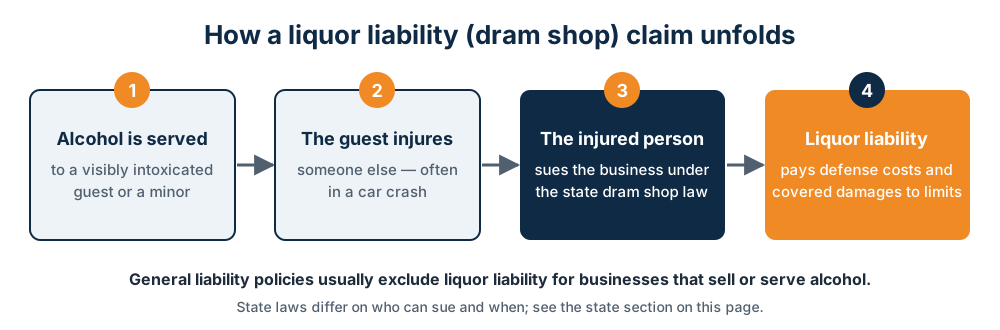
Two exclusions decide whether a California claim gets paid. First, a standard general liability policy excludes injury arising from selling or serving alcohol if you are in that business, which is why a separate liquor liability policy exists. Second, many liquor and GL policies exclude or sublimit assault and battery, and in a state where over-service suits are limited, fights and security claims are often the bigger exposure. Read the A&B wording before comparing price; see whether liquor liability covers assault claims.
Per-occurrence and aggregate limits
Liquor liability carries a per-occurrence limit, the most paid for one incident, and an aggregate limit, the most paid for all claims in the policy year. Leases usually specify both, often matching your general liability limits. Watch for an A&B sublimit that erodes the aggregate, and confirm any umbrella actually sits over the liquor policy. See per-occurrence vs aggregate limits.
How carriers price liquor liability in California
The main rating base is liquor receipts: your annual alcohol sales and their share of total revenue. A full-service restaurant where drinks are a modest part of the check is rated very differently from a nightclub where alcohol is most of the revenue. Carriers also weigh closing time, entertainment and dancing, drink promotions, security staffing, RBS compliance, ID scanning, prior claims and ABC violations. Clean POS splits between food and alcohol, training records and an incident log give underwriters a reason to compete.
Which California businesses face which issues
- Bars and taverns — highest liquor receipts, late hours and the most security claims; A&B limits come first.
- Breweries and taprooms — confirm the liquor form covers taproom pours, festivals and to-go sales alongside manufacturing.
- Fine dining and restaurants with bar programs — lower receipts ratio, but pairings and private dining still need certified servers.
- Caterers — off-premises service, venue certificate demands and under-21 guests at weddings.
- Every employer — workers’ comp is required from the first employee (Labor Code §3700), and WCIRB now separates bars (9084) and caterers (9082) from restaurants; see California restaurant workers’ comp.
Coverage checklist for a California alcohol license
- Liquor liability — responds to the alcohol-related injury claims your GL excludes.
- Assault and battery — at a limit that fits your crowd and hours, not a token sublimit.
- General liability — slips, falls and food-related injuries unrelated to drinking.
- Umbrella or excess — only helps if it schedules the liquor policy underneath.
- Employment practices liability — harassment and wrongful termination claims common in bar staffing.
Getting quoted through an independent agency
Provident Financial Group is an independent agency, so one application goes to multiple carriers and the quotes come back side by side, with liquor, A&B and umbrella terms compared line by line. Have your liquor receipts, license type, hours, RBS roster and loss runs ready. Once bound, live certificates of insurance for landlords and venues can be issued quickly. Call (866) 964-6660 or start online.
Frequently asked questions
Can a California bar be sued for over-serving an adult who then drives?
Generally not under B&P §25602(b) and Civil Code §1714(b), which place responsibility on the drinker. Claims on other theories, such as negligent security, remain possible.
What if my server pours for an obviously intoxicated 20-year-old?
That is California’s core statutory exposure: B&P §25602.1 lets the injured person sue the licensee, and ABC administrative action can follow.
How long does RBS certification last?
Three years. Servers and managers must certify within 60 days of hire, so track expiration dates for every employee.
Does my general liability policy cover alcohol claims?
Not if you sell or serve alcohol. The liquor exclusion in GL removes those claims; host liquor coverage in a GL policy is meant for businesses that do not sell alcohol.
Serving alcohol in California? Compare liquor liability, assault and battery and umbrella options from multiple carriers. Get Multiple Quotes within minutes.
Official California sources
- California ABC: licensee laws and liability
- California Business and Professions Code § 25602 (dram shop limits)
- California Civil Code § 1714 (social host and furnisher liability)
- California Civil Jury Instruction CACI No. 422 (furnishing alcohol to minors)
- California ABC: Responsible Beverage Service (RBS) training FAQ
- California ABC: enforcement FAQ
State facts on this page are drawn from the statutes and agency pages above. Laws and agency rules change, so confirm current requirements with the agency before relying on them. This page is general information, not legal advice or a coverage opinion.
Related pages
- Bar insurance in California
- Brewery insurance in California
- Catering insurance in California
- Fine dining insurance in California
- Restaurant insurance in California
- Liquor liability laws by state
- Nightclub insurance