Restaurants don’t think of themselves as technology companies, but look at what actually runs a modern dining room: a cloud point-of-sale system, online ordering, third-party delivery integrations, a reservation platform, a loyalty program full of customer emails, and a payment terminal on every counter. Each of those systems handles data that criminals want — and each is a doorway into your business.
Cyber liability insurance exists for exactly this exposure, yet it remains one of the least-purchased coverages in the restaurant industry. Owners often assume they’re too small to be targeted. In practice, attackers frequently prefer small merchants precisely because their defenses are lighter and their card volume is steady.
Why Restaurants Are Attractive Targets
A restaurant processes hundreds or thousands of card transactions a week, employs a rotating staff with shared logins, and typically has no IT department. Point-of-sale malware, phishing emails aimed at managers, and compromised vendor connections are common attack routes. Franchise and multi-location operators face additional exposure because one compromised system can spread across locations.
The other target is your people. Business email compromise — a fraudster impersonating an owner or vendor to redirect a payment — doesn’t require hacking anything. It just requires one busy manager on one busy afternoon.
What a Cyber Policy Typically Covers
Cyber policies are usually split into first-party and third-party coverage. First-party coverage responds to your own losses: forensic investigation to find out what happened, notifying affected customers, credit monitoring, restoring data and systems, business interruption while your POS is down, and in many policies, ransomware response and cyber extortion payments where legally permitted.
Third-party coverage responds when others come after you: claims from customers whose data was exposed, and — significantly for restaurants — assessments and fines from the card brands and your payment processor after a card-data breach. Many policies also offer access to a breach response team, which for a small operator may be the most valuable feature of all.
The PCI Problem Most Owners Haven’t Read About
Your merchant agreement almost certainly makes you responsible for PCI-related assessments if card data is stolen from your systems. These contractual assessments can arrive regardless of whether any customer ever sues you. General liability policies typically exclude this exposure entirely, which is why PCI coverage inside a cyber policy matters so much for food service businesses. Ask specifically whether PCI fines and assessments are covered and at what sublimit.
Where General Liability and Crime Policies Fall Short
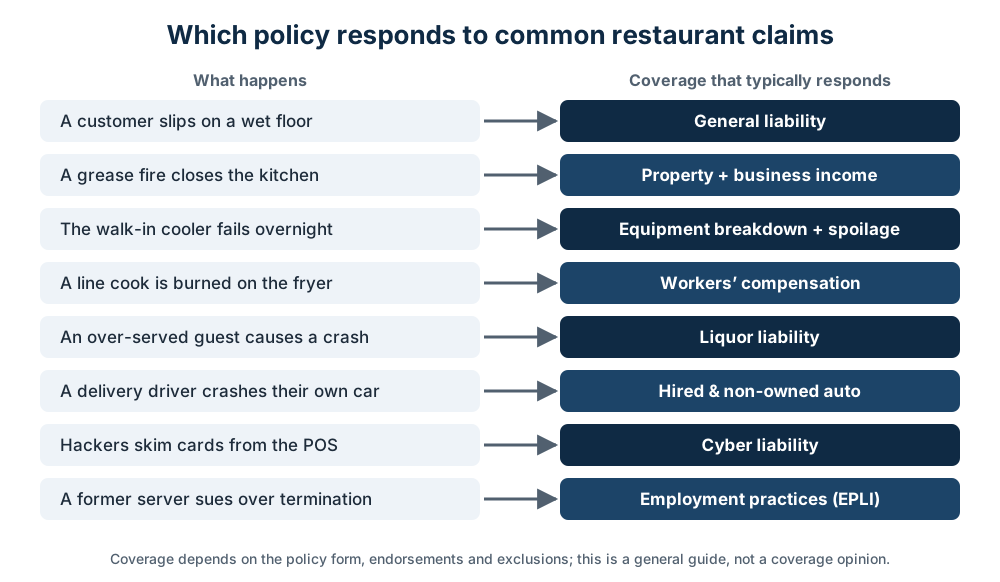
Owners sometimes assume their BOP or general liability policy will pick up a data incident. GL is built for bodily injury and property damage — a slip in the dining room, not a skimmed card number. Electronic data is generally not treated as tangible property, and many GL forms now carry explicit data-breach exclusions. A commercial crime policy may cover certain funds-transfer fraud, but it typically won’t pay for breach response, notification, or PCI assessments. The lines matter, and they don’t overlap as much as people hope.
Practical Steps That Lower Both Risk and Premium
Underwriters increasingly ask about controls before quoting. Multi-factor authentication on email and remote access, unique logins per employee, timely POS software updates, segmented Wi-Fi that keeps guests off your business network, and staff training on phishing all reduce the chance of an incident — and often improve the terms you’re offered. Backups that are tested and stored separately from your main systems can turn a ransomware crisis into an inconvenience.
Get a Quote Sized for Your Actual Operation
Cyber coverage for a single-location restaurant is often more affordable than owners expect, and the application process has gotten simpler. An independent agent can help you compare forms — which vary widely — check PCI coverage, match limits to your transaction volume, and coordinate cyber with your existing BOP so nothing falls between policies. If your restaurant takes cards or keeps customer data, it has a cyber exposure worth insuring — talk it through before an incident, not after.