
Fast food restaurants in Vermont typically need general liability for high-traffic counters and parking lots, commercial property with business income for fryer-driven fire risk, hired and non-owned auto if staff deliver, crime coverage for cash handling, and workers’ compensation from the first employee. Franchise agreements and landlords usually dictate minimum limits and additional insured wording.
This page is for quick-service burger, chicken, sandwich and taco operations in Vermont, independent and franchised, with or without a drive-thru. Speed, volume and long hours define the risk, and Vermont’s winters make the parking lot and drive-thru lane a year-round focus.
State requirements behind a Vermont quick-service policy
Workers’ compensation is required for any employer with one or more full- or part-time employees in Vermont, and fast food payrolls are large and turn over quickly. Vermont uses NCCI as its rating bureau, and NCCI’s Vermont advisory loss costs include class 9083 (Restaurant – Fast Food) alongside 9082 (Restaurant NOC). Which code applies to your payroll is an underwriting determination, so describe your operation accurately. Coverage comes from private carriers or the assigned risk plan; there is no state fund. See our Vermont restaurant workers’ comp page.
The Vermont Department of Health’s Food and Lodging Program licenses and inspects restaurants statewide, and new locations must pass an opening inspection. If staff deliver in their own cars, remember that Vermont’s minimum auto liability is 25/50/10 (in thousands of dollars) under 23 V.S.A. § 800, and personal policies commonly exclude delivery use, which is why hired and non-owned auto matters.
Franchisees should read the franchise agreement’s insurance section line by line. It typically sets required coverages, limits, additional insured wording and notice provisions, and a franchisor can treat a lapse as a default.
Common fast food losses in Vermont
- Drive-thru ice. A customer steps out of a car at the pickup window onto black ice. Plowing and salting logs become the key evidence.
- A car through the front glass. A driver confuses the pedals in a tight lot and strikes the dining room. The building damage is a property claim; injured customers inside are a liability claim.
- Fryer and hood fire. A fryer thermostat fails during the lunch rush; the suppression system discharges, and the store is closed while the hood, ducts and equipment are cleaned or replaced.
- Late-night robbery. A robbery at close injures a shift lead and takes the night’s deposit, creating a crime loss and a workers’ comp claim.
- Grease burns and slips. Hot oil changes, wet floors behind the line and walk-in freezer falls are the recurring employee injuries.
- A foreign object in a sandwich. A customer bites into a piece of packaging or metal and files a products claim.
Quick-service coverage essentials
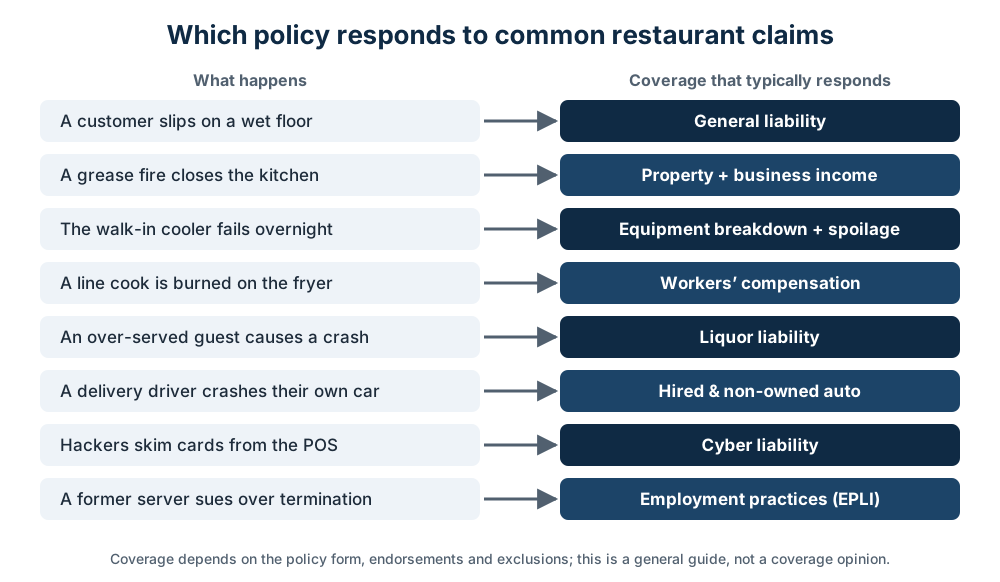
- General liability — customer slips, parking lot and drive-thru injuries.
- Products-completed operations — foreign object, illness and allergen claims.
- Commercial property — building or improvements, fryers, hoods, freezers and signage.
- Business income and extra expense — lost profit and payroll while a fire-damaged kitchen is repaired.
- Equipment breakdown and spoilage — fryer controls, ice machines, walk-in compressors.
- Crime and employee dishonesty — cash register and deposit losses, including theft by employees.
- Hired and non-owned auto — delivery and bank runs in employees’ cars.
- Employment practices liability — high-turnover workforces generate hiring, firing and harassment claims.
- Workers’ compensation — mandatory from the first employee in Vermont.
Rating factors for high-volume counter service
Underwriters weigh annual sales, payroll by class code, hours (late-night and 24-hour operations rate higher), drive-thru presence, fryer count, hood suppression and cleaning records, security measures, franchise versus independent status, building age and sprinklers, and loss history.
To improve pricing: document snow and ice removal, keep suppression inspections and hood cleaning current, use drop safes and limit cash on hand, install cameras, train staff on oil handling with protective gear, and keep a written return-to-work program for injured employees.
How we shop a fast food account
Provident Financial Group is an independent agency licensed in Vermont. We take one application, compare multiple carriers side by side, and check each quote against your franchise agreement or lease requirements. After binding, you can issue live certificates of insurance to your franchisor and landlord. Call (866) 964-6660. Coverage is subject to underwriting and policy terms.
Frequently asked questions
What workers’ comp class code applies to a Vermont fast food restaurant?
NCCI’s Vermont loss costs include 9083 (Restaurant – Fast Food) and 9082 (Restaurant NOC). The carrier assigns the code based on how your operation actually works.
Does my franchisor’s insurance cover my Vermont location?
No. Franchisees insure their own locations and usually must name the franchisor as additional insured on their policies.
Who pays when a customer falls in the drive-thru lane?
That is typically a general liability claim, though a lease may shift parking lot responsibility to the landlord or tenant. Check the lease and keep snow removal records.
Is employee theft covered by my property policy?
Usually not. Employee dishonesty is handled under a crime policy or endorsement.
Opening a new location or reviewing an existing one? Get Multiple Quotes within minutes.