
Ghost kitchens in Kansas typically need products liability that covers every virtual brand cooked on site, hired and non-owned auto for any delivery driving by staff, commercial property with spoilage for a kitchen that never closes its walk-in, and workers’ compensation once gross annual payroll exceeds $20,000. Delivery platforms and shared-kitchen operators usually set their own insurance terms on top.
This page is for delivery-only operators in Kansas: a single cook line running three virtual brands out of a leased space in Wichita, a restaurant that added a delivery-only concept in its back kitchen, or a tenant in a shared commissary near Overland Park. No dining room means fewer slip-and-fall visitors, but it shifts the risk toward product, vehicles and contracts.
Kansas licensing, auto law and payroll rules for delivery-only kitchens
A ghost kitchen still needs a food establishment license from the Kansas Department of Agriculture’s Food Safety & Lodging program. Kansas does not require a certified food protection manager statewide, although KDA recommends one and local health departments may set their own rules. Insurers ask about food safety training for delivery-only operations because every order leaves the building without a server checking it.
If your own employees drive orders, Kansas auto law matters. The state minimum is 25/50/25 (in thousands of dollars), and every Kansas auto policy must also carry PIP and uninsured/underinsured motorist coverage. A driver’s personal policy is the first layer when they use their own car, but the kitchen can still be named in a lawsuit, which is exactly the gap hired and non-owned auto fills.
Workers’ comp is required for employers with more than $20,000 in gross annual payroll, and subcontractors do not get the small-payroll exemption. Kitchens that run late-night shifts across multiple brands usually cross that line early. Details are on our Kansas restaurant workers’ comp page.
How a ghost kitchen gets sued without a dining room
The classic ghost kitchen claim is a product claim that is hard to trace. A customer orders a curry bowl from one of your virtual brands through an app, has a severe peanut reaction, and the menu listing on the platform never mentioned peanut oil. The platform points to you, and your general liability and products coverage has to defend it.
Driving is next. A line cook runs a catering-size order across town in his own car and rear-ends a stopped vehicle on Kellogg. His personal carrier pays up to its limit, and the injured driver’s lawyer adds your company to the suit. Without hired and non-owned auto, that defense comes out of your pocket.
Then the equipment. A kitchen running sixteen hours a day wears out compressors and fryer thermostats faster than a traditional restaurant, and a walk-in failure can wipe out inventory for several brands at once. A Kansas wind event that knocks out power overnight produces the same spoilage loss. Tablets and online ordering add a data exposure if customer or payment information is compromised.
Insurance lineup for a Kansas ghost kitchen
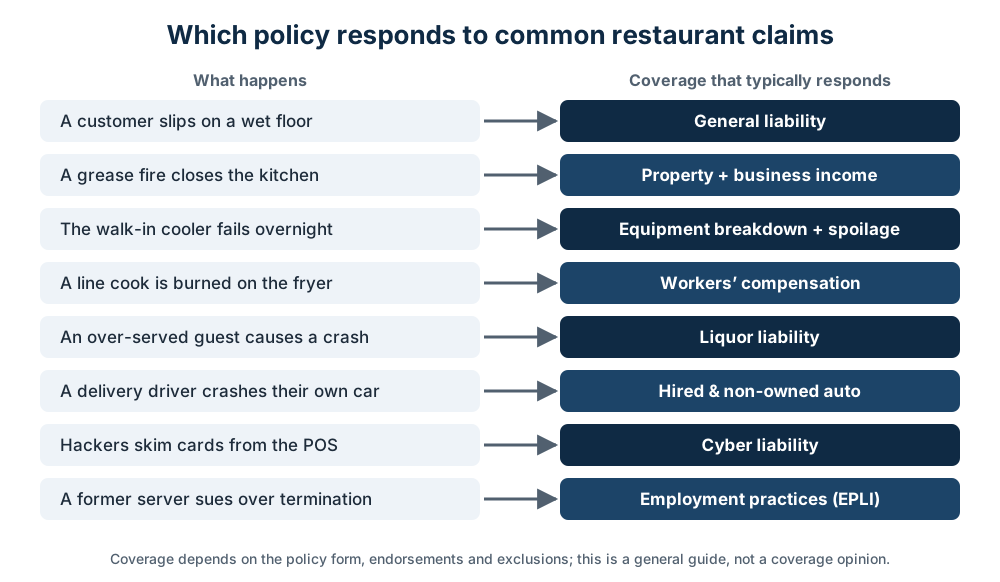
- General liability — required by landlords and shared-kitchen operators, and the base layer for third-party injury claims.
- Products-completed operations — foodborne illness, allergen and foreign-object claims from delivered meals under any brand name.
- Hired and non-owned auto — protects the business when employees deliver in personal or rented vehicles.
- Commercial auto — needed if the kitchen owns its own delivery vehicles.
- Commercial property — cooking equipment, hoods and improvements you own inside a leased or shared space.
- Equipment breakdown and spoilage — high-hour refrigeration and cooking gear, plus stock lost in a power outage.
- Workers’ compensation — required above the payroll threshold; burns and knife cuts dominate kitchen claims.
- Cyber liability — online ordering accounts, customer data and payment systems.
Rating factors specific to delivery-only operations
Underwriters look at total sales, how many brands and cuisines you run, the cooking methods (deep frying and wok cooking rate differently from cold prep), hours of operation, whether staff deliver or all delivery goes through third-party drivers, building and fire protection details, and your loss history. Being a tenant in a shared commissary also means reading that operator’s contract, which may require additional insured status and waivers of subrogation.
Keep pricing reasonable by using platform drivers or a documented employee driving policy, keeping allergen information accurate on every brand’s menu listing, logging walk-in temperatures with alarms, and keeping hood cleaning and suppression service current. Clean loss runs from your prior policy help at every renewal.
Our process for quoting ghost kitchens
Provident Financial Group is an independent agency, so one application goes to multiple carriers and you see the quotes side by side, including how each handles delivery driving and multiple brands. After you bind, live certificates of insurance are available for your landlord, commissary operator or delivery partners. You can also reach us at (866) 964-6660.
Frequently asked questions
Does one policy cover all of my virtual brands?
It can, as long as each brand and its menu are disclosed on the application. An undisclosed brand or cuisine is a common source of coverage disputes.
Do delivery apps require insurance from a Kansas ghost kitchen?
Many platforms and shared kitchens set their own requirements, often general liability and sometimes additional insured status. Check your merchant agreement and send us the wording.
Is hired and non-owned auto required by Kansas law?
Kansas law sets minimums for vehicle owners, not for businesses whose employees drive their own cars. Hired and non-owned auto is a business decision, but it closes a real gap for kitchens with employee drivers.
Will my coverage respond if the shared kitchen floods?
Standard property policies exclude rising-water flood, which the Kansas Insurance Department recommends insuring separately through NFIP. Your own equipment needs property coverage regardless of what the host kitchen carries.
Launching a new virtual brand or moving into a shared kitchen? Get Multiple Quotes within minutes.