
Bars and taverns in Vermont typically need liquor liability, general liability that includes assault and battery, commercial property written for snow load, frozen pipes and flood, and workers’ compensation for every employee. Vermont’s dram shop statute lets people injured by an over-served or underage patron sue the licensee, and a newer law ties liquor liability insurance to getting or renewing your license.
This guide is for owners of neighborhood taverns, ski-town après spots, college-town pubs and cocktail rooms that hold a first-, third- or fourth-class license from the Vermont Department of Liquor and Lottery (DLL). It covers what state law actually requires, the claims that hit Vermont bars hardest, and how to assemble a program that satisfies your license, your landlord and your lender without paying for coverage you don’t use.
How Vermont’s dram shop law reaches your bar
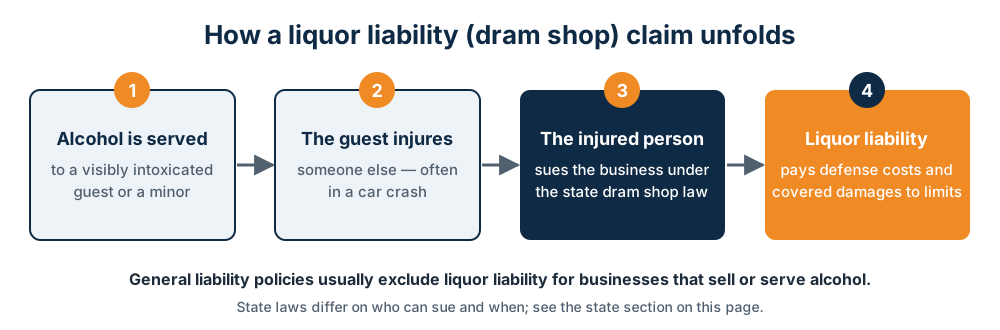
Vermont’s dram shop statute, 7 V.S.A. § 501, is broad. Any person injured by an intoxicated patron can sue a first-, third- or fourth-class licensee that unlawfully sold or furnished alcohol to a minor, served after legal hours, or negligently served someone apparently under the influence when a reasonable and prudent person would have known better. The intoxicated patron cannot bring the claim, but a passenger, another driver or someone hurt in a fight can. The statute sets no damages cap, and Vermont case law applies a two-year window to file.
Landlords get pulled in too. A building owner who knew or had reason to know a tenant was serving unlawfully can be named as a defendant, which is why Vermont bar leases usually demand liquor liability with the landlord listed as an additional insured.
Vermont’s liquor liability insurance mandate for licensees
Act 17 of 2023 added subsection (i) to § 501. It requires first-, third- and fourth-class licensees to carry liquor liability insurance meeting minimum coverage requirements set by DLL rule, in consultation with the Department of Financial Regulation, before a license is issued or renewed. The minimum is set by that rule rather than written into the statute, and the date the requirement takes effect has been revised since the law passed, so confirm the current rule and effective date with DLL before your renewal. We build your limit around whatever DLL requires and whatever your lease demands, whichever is higher.
Server training runs alongside it. Every Vermont seller and server of alcohol must complete DLL-approved training before starting work and retrain every two years, through a DLL seminar, DLL online training or an in-house trainer certified through DLL’s Train the Trainer program. Underwriters ask for those records, and a well-kept training file helps you defend an over-service claim. Workers’ compensation is also mandatory once you have a single full- or part-time employee.
Claim scenarios that keep Vermont tavern owners up at night
The classic Vermont loss is the winter drive home. A patron leaves a mountain-road tavern after a long après session, loses control on an icy curve and injures an oncoming driver. The injured driver’s attorney subpoenas your POS tickets and camera footage to argue your staff kept pouring after visible signs of intoxication. That is a liquor liability claim, and without the coverage it lands on your business directly.
Fights are the second driver. A doorman escorts an argumentative customer out, the customer falls on the front steps and breaks a wrist, and the suit alleges excessive force. Many liquor and general liability forms exclude or sublimit assault and battery, so read that language line by line before you bind.
Then there is the building itself. A February cold snap on a night the bar is closed freezes a sprinkler line above the back bar; the thaw floods the floor, the walk-in and the basement keg room. Ice dams along the eaves, heavy snow on a flat rear addition, and river flooding like the July 2023 storms that swamped Vermont downtowns are all realistic. Standard commercial property typically excludes flood, so a riverside tavern needs a separate flood policy.
Vermont bar coverage checklist
- Liquor liability — responds to dram shop suits under § 501 and satisfies the licensee insurance requirement once DLL’s rule applies to you.
- General liability — covers slips on icy entries, patron injuries from furniture or stairs, and damage to a customer’s property.
- Assault and battery coverage — confirms fights and doorman ejections are not excluded; ask for a full limit rather than a thin sublimit.
- Commercial property — building or tenant improvements, bar equipment and inventory, with attention to freeze-up and snow-load wording.
- Flood insurance — a separate policy for taverns near rivers or in low-lying downtown blocks.
- Business income — replaces lost income while you repair after a covered pipe burst or fire during peak ski or foliage weekends.
- Equipment breakdown and spoilage — protects walk-in coolers, draft systems, ice machines and the inventory they hold.
- Workers’ compensation — required in Vermont with even one part-time employee.
- Umbrella liability — extra limit above liquor and general liability for a severe crash claim.
Pricing factors for a Vermont tavern policy
Liquor liability is rated largely on alcohol sales and the share of revenue that comes from alcohol, so a pub with a strong food menu often rates differently than a late-night shot bar. Closing time, live music or dancing, occupancy, security staffing and prior incidents all matter. On the property side, underwriters look at building age, heating system, sprinklers, wiring, distance to a river and how long the building sits empty between shifts.
Ways to earn better terms: keep DLL training certificates current for every server, run an ID scanner, log every refused service and incident, keep camera footage for a meaningful period, and keep a written snow-and-ice removal log. Low-temperature alarms and a plan for keeping heat on during closed days show an underwriter you actively manage the freeze exposure.
How quoting works with our independent agency
US Restaurant Insure is the restaurant and bar brand of Provident Financial Group, an independent agency. You complete one application, we shop it with multiple carriers quoted through our agency, and we lay the options side by side so you can compare liquor limits, assault and battery wording and property deductibles. Once you bind, you get live certificates of insurance to send to your landlord, lender or DLL. Questions? Call (866) 964-6660.
Frequently asked questions
Can someone sue my Vermont bar if a patron drives drunk after leaving?
Yes. Under 7 V.S.A. § 501, a person injured by an intoxicated patron can sue a licensee that negligently served someone apparently under the influence, served a minor, or served after legal hours. The intoxicated patron cannot sue.
What liquor liability limit will Vermont require for my license?
The minimum is set by DLL rule, not in the statute itself, and the effective timing has shifted since the law passed. Check DLL’s current guidance before renewal; your lease or lender may require a higher limit anyway.
Do my bartenders need state-approved training?
Yes. Everyone who sells or serves alcohol in Vermont must complete DLL-approved training before starting and retrain every two years.
Will my property policy pay for a burst pipe in January?
Sudden pipe bursts are commonly covered, but many policies restrict freeze losses when heat was not maintained in a vacant or closed building. Flood from a rising river is usually excluded and needs its own policy.
Vermont bar owners can compare liquor, liability and property options from multiple carriers in one pass. Get Multiple Quotes within minutes.