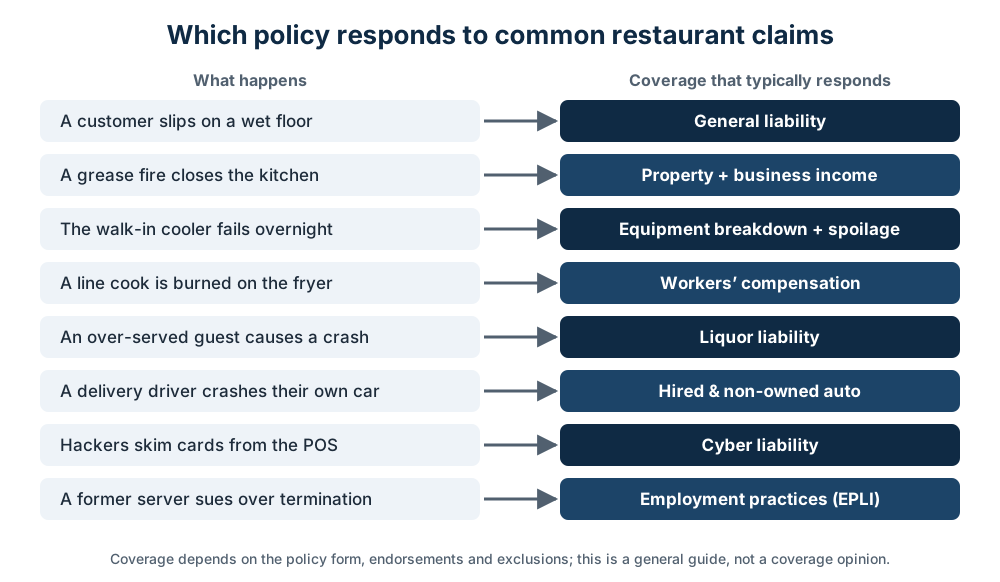
Every restaurant owner knows the math of thin margins. What fewer owners think about is what happens to that math when the doors are forced shut for weeks or months. Rent, loan payments, insurance premiums, and key salaries do not pause just because the kitchen did, and a closure that starts as a property problem can quickly become a survival problem.
Business interruption insurance, also called business income coverage, exists for exactly this scenario. It is one of the least understood coverages in a restaurant policy, and also one of the most important. Here is how it generally works, what it tends to pay for, and what to look at before you ever need it.
What Business Interruption Insurance Is Designed to Do
Property insurance pays to repair or replace physical things, such as a fire-damaged kitchen or a collapsed ceiling. Business interruption coverage addresses a different loss entirely: the income that never arrives while you are closed and rebuilding.
The idea is to put your restaurant roughly where it would have been financially if the loss had never happened. If a covered event shuts you down, the coverage may replace lost profits and help pay expenses that continue whether or not you are serving customers.
For restaurants, this matters more than for many other businesses. A retailer can sometimes sell online during repairs, but a dining room that is closed produces nothing. Income stops the day the incident happens and does not return until you are open and guests come back.
What Actually Triggers the Coverage
This is the part that catches many owners off guard. Business interruption coverage is usually tied to direct physical damage to your property from a peril your policy covers. A kitchen fire, a burst pipe that floods the dining room, or storm damage to the roof are typical examples of events that may trigger it.
The flip side is just as important. A closure with no covered physical damage behind it, such as a slow season, a road construction project that kills foot traffic, or a government order unrelated to damage at your property, is often not covered. Policies vary, and some include limited extensions, but the general rule is that the interruption must flow from a covered property loss.
Some policies do include civil authority coverage, which may respond when a government order closes your area because of covered damage to nearby property, such as a fire on your block. This coverage is typically limited in duration and depends heavily on policy language, so it is worth understanding before you rely on it.
What the Coverage Typically Pays For
The core of a business interruption claim is lost net income, generally measured by what your restaurant would reasonably have earned during the closure based on its history and trajectory. A restaurant that was growing month over month may be able to make that case with good records, which is one reason clean books matter.
Continuing expenses are the second piece. Rent or mortgage payments, loan obligations, taxes, and utility minimums often continue during a closure, and business income coverage may help keep those paid. Many policies can also address payroll for key employees, which can be the difference between reopening with your chef and managers or starting over with a new team.
Many policies also include extra expense coverage. This may help with costs that go beyond normal operating expenses but that reduce the overall loss, such as renting temporary equipment or paying for expedited repairs so you can reopen sooner. In some cases spending more to shorten the closure is cheaper for everyone, and policies are often written to recognize that.
Why the Restoration Period Deserves Your Attention
Business interruption coverage does not run forever. It generally pays during the “period of restoration,” which usually starts at the time of the loss and ends when the property is repaired or should reasonably have been repaired. If rebuilding takes longer than expected because of permitting delays, contractor shortages, or supply problems, the gap between the theoretical timeline and the real one can become painful.
There is also an often-overlooked problem: reopening is not the same as recovering. A restaurant that reopens after six months rarely returns to full sales on day one, because regulars have formed new habits. An extended business income option may continue coverage for a period after reopening while sales rebuild, and many restaurant owners find this extension is worth discussing.
Waiting periods matter too. Many policies apply a short time deductible, often measured in hours, before income coverage begins. Knowing that number in advance helps you plan for the first days after a loss.
How to Prepare Before You Ever File a Claim
The strength of a business interruption claim rests on documentation. Sales records, profit and loss statements, tax returns, and payroll records are what turn “we lost a lot of business” into a number an insurer can pay. Keeping copies backed up away from the restaurant, whether in the cloud or simply off-site, means a fire cannot destroy both your kitchen and your proof of income.
It also helps to sanity-check your limits once a year. Ask yourself how long a full rebuild would realistically take in your market, what your monthly fixed costs actually are, and whether your current limit would carry you that far. Restaurants that have grown since the policy was written are often underinsured without knowing it.
Finally, understand how your coverage is structured. Some policies pay up to a monthly limit, others up to a total limit over the restoration period, and the differences affect how a long closure plays out. None of this is exciting reading, but it is far easier to sort out over coffee than after a fire.
No one opens a restaurant planning for the day it has to close, but the owners who recover fastest are usually the ones who thought it through beforehand. An independent agent who works with restaurants can walk through your income, your fixed costs, and your likely rebuild timeline, and then help you compare how different carriers structure this coverage. If you are not sure how long your current policy would keep the lights on, it may be worth a conversation before the question ever stops being hypothetical.