Almost every restaurant general liability policy contains an assault and battery provision. Most owners have never read it, and many are surprised to learn it is often an exclusion rather than a coverage. If a fight breaks out in your dining room or a security incident escalates in your parking lot, that single paragraph can decide whether your policy responds at all.
This is not a reason to panic about your coverage. It is a reason to know what your form says before an incident forces the question.
Why This Exclusion Exists
Insurers price general liability around ordinary business risks. A guest slips on a wet floor, a server drops a tray, a chair collapses. Those are accidents arising from normal operations, and they behave predictably enough to underwrite.
Intentional violence behaves differently. Claims tend to be severe, litigation is expensive, and the exposure is heavily influenced by factors carriers cannot easily measure from an application, such as the surrounding neighborhood, crowd management practices, and how late alcohol is served.
Rather than price that uncertainty into every policy, many carriers exclude it and then offer it back selectively, often with a separate limit and sometimes at additional cost. For restaurants with a bar, late hours, or live entertainment, this has become common.
How the Language Typically Shows Up
You will generally see one of three approaches on a restaurant policy.
A full exclusion removes coverage for bodily injury or property damage arising out of assault or battery, regardless of who committed it. Some versions extend the exclusion to related allegations such as negligent hiring, training, or supervision of staff, which is the theory plaintiffs most often use to reach the business.
A sublimit approach provides coverage but caps it well below your main general liability limit. A policy with a one million dollar occurrence limit might carry an assault and battery sublimit of a fraction of that.
A full grant of coverage, with assault and battery treated like any other covered occurrence, does exist but is less common for accounts with meaningful alcohol or nightlife exposure.
The Negligent Supervision Wrinkle
This is the detail worth understanding most. When an incident occurs, the injured party rarely sues only the person who threw the punch. They typically sue the business as well, alleging the restaurant was negligent in some way, by overserving, by failing to provide adequate security, by hiring a bouncer without a background check, or by ignoring a situation that was visibly escalating.
A narrowly written exclusion that only mentions assault and battery might leave room to argue those negligence claims are separate. A broadly written one expressly folds in negligent hiring, training, supervision, and failure to protect, closing that argument off.
Two policies that look similar on a proposal can differ sharply here. The distinction only becomes visible when you read the endorsement itself.
Where It Interacts With Liquor Liability
Restaurants that serve alcohol often carry separate liquor liability coverage, and it is easy to assume that policy picks up anything alcohol-related. It may not.
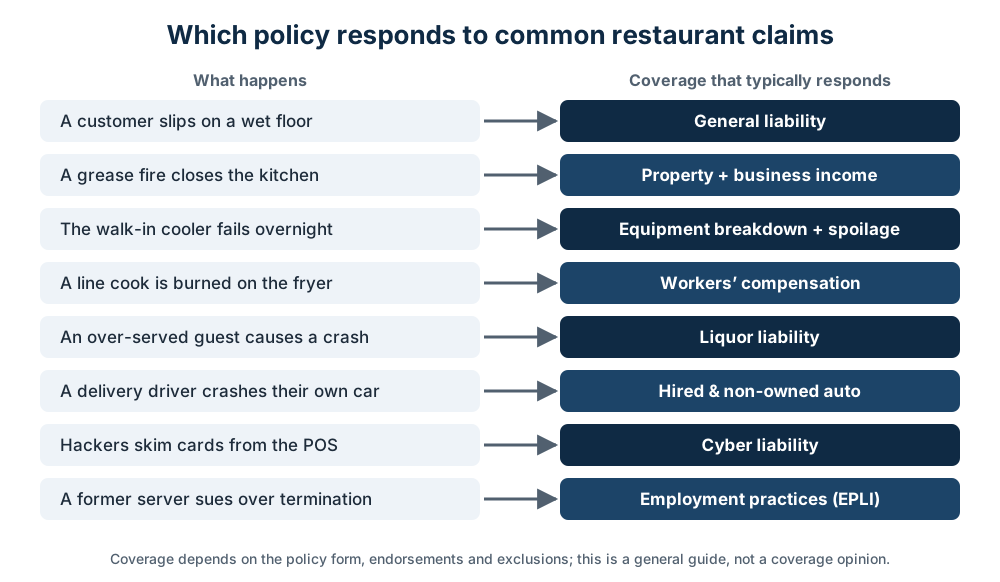
Liquor liability generally responds to claims arising from serving alcohol to someone who then causes harm, commonly a drunk driving incident after leaving your establishment. An altercation between two patrons inside your restaurant is frequently treated as an assault and battery matter rather than a liquor matter, and the liquor policy may carry its own assault and battery exclusion.
The result is that an incident can fall between two policies, each pointing at the other. Checking both forms for the same exclusion is a reasonable precaution for any restaurant with a bar.
Practical Steps for Owners
Start by locating the language. Search your policy for the words assault and battery and read the endorsement in full, including whether it mentions negligent hiring or supervision.
Then consider your actual exposure honestly. A breakfast and lunch cafe closing at three in the afternoon sits in a different risk category than a restaurant with a late-night bar crowd and a security staff. The second profile makes this coverage question far more pressing.
Documented practices help regardless of coverage. Server training on responsible alcohol service, a written policy for handling escalating situations, incident logs, background checks on security personnel, and functioning cameras all reduce the likelihood of a claim and support your defense if one arrives.
If you use contracted security, review their insurance and the indemnity language in your agreement with them. Who is responsible for what should be settled on paper before an incident, not after.
Getting a Clear Answer
This is a coverage question with no universal answer, because the forms genuinely differ from carrier to carrier and endorsement to endorsement. What matters is knowing which version sits in your policy today.
An independent agent working with restaurant and hospitality accounts can pull the relevant endorsement, explain in plain terms what it does, and where appropriate look at what other markets offer for a business with your particular profile. If you are not certain what your policy says about assault and battery, that is worth a conversation before the question becomes urgent.